Tuesday 08 / September / 2026
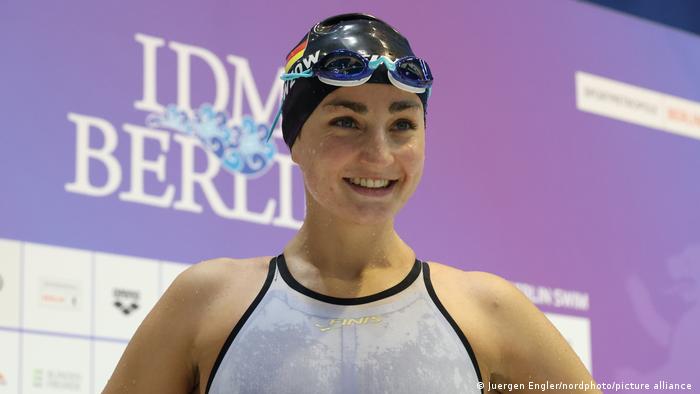
It was the final turning point for Elena Kravtsov, as she was then known, in the final race of the 100-meter breaststroke at the Paralympics in Tokyo in 2020. The almost completely blind swimmer was about a second behind Britain's Rebecca Redfern. It was a nail-biter. Kravtsov fought to gain on her competitor, but only in the last few meters did the 27-year-old overtake Redfern and reach the edge of the pool first. With a lead of 0.64 seconds, she won gold.
Kravstov, who was born in Kazakhstan, had claimed silver over the same distance at London in 2012, but this was her first gold medal win at the Paralympics. "That was the last medal I was missing," the athlete recalled in an interview with DW. "After 10 years of hard work, a real weight fell off my shoulders."
Previously, Kravtsov had collected titles at European and world Championships, but with gold at the Paralympics, the swimmer had reached the pinnacle of her career.
"Many athletes fall into a hole after such a title. It wasn't like that for me at all. I had a wonderful time afterwards and really enjoyed it," she explained. "My headaches, which plagued me, were the only reason I couldn't enjoy every day."
"When will I be able to train again?"
Those headaches led to Kravtsov getting a checkup with her doctors. The day she got the diagnosis, she and her fiance had just picked out wedding rings. Afterwards, she went for an MRI exam.
"After the first diagnosis, it was clear that something was wrong. And then after another examination, I was told that there was a brain tumor in my head. That was a blow, of course," she says.
Suddenly, life was different. "There was no longer any joy, happiness or euphoria, just fear and uncertainty. I didn't know what was coming," she recalled.
The swimmer cancelled all appointments and made her illness public in late 2021.
"I didn't want to hide it. I didn't want people to ask me weird questions," she says. "That helped me a lot. I had a pretty good handle on it, and I think I handled it very well."
In early November, two days before the surgery, Kravtsov married her fiance, long-time coach, Philip Semechin, and changed her last name. The wedding and surgery were another turning point in the competitive athlete's life. After the tumor was removed, she immediately began looking ahead.
Giving up has never been an option for the now 28-year-old. She wanted to get back into the pool as soon as possible. "After the surgery, I woke up and immediately asked the doctor when I could train again."
Training and chemotherapy in tandem
Barely one week later, she began chemotherapy. At first, Semechin only trained outside the pool to allow the scar from the operation to fully heal.
"Competitive sports helped me a lot during this phase because my body is used to extreme stress. I learned early on what it means to push the limits physically and mentally. I benefit a lot from that," Semechin explained. Her fighting spirit had been awakened.
Together with her trainer-husband, she adjusted her training plans to include more recovery phases, "so that I don't completely destroy myself and then can't take the chemo anymore," she said.
Semechin had to listen to her body more than ever, since the cycles of chemotherapy would have different impacts. Sometimes she can exercise more and sometimes less, she explains. "Finding that balance between rest and stress and regulating my athletic ambition down a bit" are the biggest challenges in the current situation, she said.