Sunday 12 / July / 2026
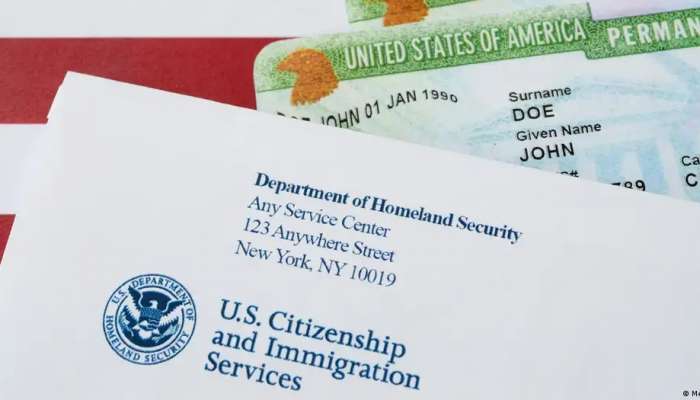
Washington DC: United States President Donald Trump announced drastic measures against immigration in late November. All asylum procedures were suspended indefinitely "until we can ensure that every alien is vetted and screened to the maximum degree possible," Joseph Edlow, director of US Citizenship and Immigration Services (USCIS), posted on X.
Further restrictions have since been imposed on nationals from 19 countries. These include entry bans and the suspension of all immigration applications and naturalizations. The granting of permanent residence and work permits, known as green cards, has also been suspended for people of the nationalities in question. USCIS chief Edlow said the president had also directed him to conduct "a full scale, rigorous re-examination of every green card for every alien from every country of concern," including holders of residence permits that have already been granted.
What sparked the immigration crackdown?
The background to these new policies is an attack on two National Guard soldiers in Washington on November 26. The two men were seriously injured by gunshots in the center of the US capital, and one of the victims later died. The suspected attacker, a 29-year-old Afghan, was arrested and charged with murder. According to media reports, he entered the US in 2021, the year of the chaotic US troop withdrawal from Afghanistan, having previously worked for the Central Intelligence Agency (CIA) and other US government agencies in his home country.
But the Trump administration's recent response is in line with asylum and migration policies that have become increasingly rigid in recent months. The US president used this incident to once again sharply criticize immigration under Joe Biden, claiming that, like many others, the alleged assassin had entered the country "unchecked" during his predecessor's term in office.
But a US government file revealed that the alleged gunman was actually granted asylum this year under Trump, Reuters reported.
Which countries are affected?
The immigration ban applies to citizens of countries on three continents. In Asia, this includes Afghanistan, Yemen, Iran, Turkmenistan, Myanmar, and Laos. In Latin America, the ban applies to Cuba, Haiti, and Venezuela. But most of the sanctioned countries are in Africa: Libya, Chad, Sudan, Eritrea, Somalia, Sierra Leone, Togo, Equatorial Guinea, the Republic of Congo and Burundi.
These are all the same 19 countries for which the US government imposed entry bans in June 2025. And these restrictions have now been tightened once again. They are considered "high-risk" because US authorities say that they don't receive enough reliable information about their nationals to conduct security checks. Many of these countries are also accused of failing to cooperate in taking back people who have been required to leave the US.
How are immigrants impacted?
The new restrictions have far-reaching consequences for the individuals concerned: all green card applications, naturalisations, and asylum procedures have been put on hold for the time being. Those affected cannot pursue their applications, even if they were already being processed. Even green card holders could lose their permanent residency status after a new security check. In the worst case, they would then face deportation to their home countries.
Late this week, it was announced that the US government would also shorten the maximum validity period of work permits for refugees, asylum seekers, and other migrants — from five years to 18 months.
Since all asylum applications are currently on hold, war refugees and people facing political persecution from around the world will no longer find a safe haven in the US. The additional issue of reuniting affected families has now also been made extremely difficult or even impossible because family members will no longer be admitted to the country.
But the US economy is also facing negative consequences as a result of these policies. The freeze affects sectors that are heavily dependent on foreign workers, particularly in health, science, and technology. The refusal to issue visas, green cards, or work permits makes it difficult to import talent and skilled workers in these areas.
Who has criticized these policies?
While the US government considers the measures necessary steps to protect national security, Democratic lawmakers and human rights organisations have been critical. "Nothing meaningfully links the 19 countries except the administration's opportunistic stigmatisation and exclusion of people based on where they were born," Tanya Greene, US programme director at Human Rights Watch, said in a statement.
"This sweeping change is not about safety. It is about scapegoating entire nationalities to justify discriminatory policies."