Sunday 27 / September / 2026
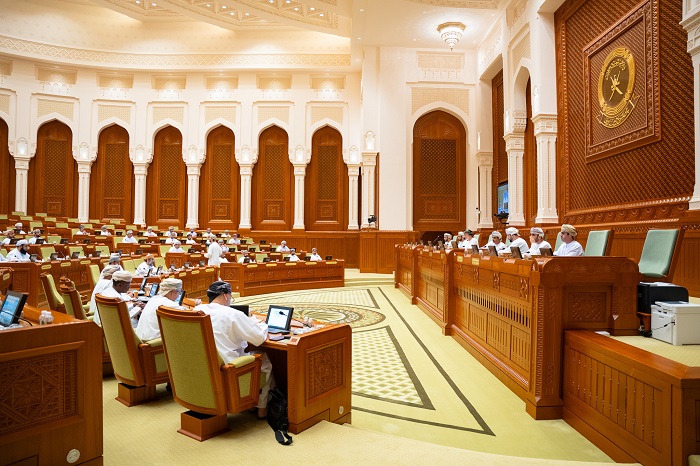
Muscat: The Shura Council on Wednesday concluded its deliberations on the draft Comprehensive Economic Partnership Agreement (CEPA) between the Government of the Sultanate of Oman and the Government of the Republic of India, referred to the Council by the Cabinet in accordance with Article (54) of the Law of the Oman Council.
The Article stipulates that draft economic and social agreements the Government intends to conclude or accede to must be referred by the Cabinet to the Shura Council to enable it to present its views and submit its conclusions to the Cabinet for appropriate action.
The session commenced with an address by Khalid Al Maawali, Chairman of the Shura Council, who reaffirmed that the session reflects the Council’s contribution to shaping development plans and the programmes implemented by State institutions, in a manner that supports stability and sustainable prosperity across all development sectors.
He added that one of the key items on the agenda was the briefing on the Comprehensive Economic Partnership Agreement between the Sultanate of Oman and the Republic of India and the discussion and endorsement of the perspective submitted by the Economic and Financial Committee regarding the agreement.
Ahmed Al Sharqi, Chairman of the Economic and Financial Committee and Rapporteur for this session, presented the Committee’s report on the draft agreement.
He noted that as part of its in- depth study, the Committee hosted Qais Al Yousef, Minister of Commerce, Industry and Investment Promotion, along with the technical team responsible for negotiations with the Indian side, to review the various dimensions of the agreement and assess its economic and investment implications.
He explained that the Committee examined several essential economic considerations, foremost among them the impact of the agreement on the local market, the opportunities and incentives it may provide for the national economy, and the challenges that require proactive preparation.
The session witnessed extensive discussions on the Committee’s report, focusing on analysing the expected economic effects of the agreement and its projected implications for Oman’s economic performance.
Discussions also assessed the impact of the agreement on the small and medium enterprise sector, one of the key pillars of economic growth and sustainable development.
Members emphasised the importance of evaluating domestic economic sectors that may be affected by the provisions of the agreement and identifying mechanisms to mitigate any potential adverse impacts, ensuring alignment with Oman’s development priorities, supporting the competitiveness of national products in local and international markets, and enhancing access to global markets.
At the conclusion of the deliberations, the Council approved the agreement.
It is worth noting that the CEPA aims to enhance trade between the two friendly countries and increase bilateral trade flows by eliminating or reducing trade barriers, including customs duties and para-tariffs on goods of origin in both countries.
The agreement also facilitates improved market access, fosters an enabling trade and investment environment, and promotes economic growth, investment, and shared prosperity.
Moreover, it provides fair competition, preferential treatment for goods originating in both countries, and parity with domestic products, thereby safeguarding the interests of traders and producers on both sides.
Behavioural challenges among school students
The session also discussed the report of the Committee for Education, Research, Innovation regarding the motion on addressing behavioural challenges among school students.
Jamal Al Abri, Deputy Chairman of the Committee and Rapporteur for the session, indicated that the Committee reviewed the educational and technical dimensions of the topic and formulated recommendations aimed at enhancing the quality of school education in the Sultanate of Oman.
He added that the Committee’s study stems from its commitment to supporting efforts to improve the education system and its outputs and to developing an integrated educational ecosystem that meets societal expectations and future requirements.
The motion focuses on addressing behavioural challenges among students in public schools as one of the key issues affecting the quality of education and the school environment.
It seeks to identify the causes behind the rise of negative behaviours, the challenges faced by schools, and to provide integrated legislative, procedural, and educational solutions that strengthen moral values, support specialised staff, and enhance the role of families and communities in guiding student behaviour.
He noted that the shortage of psychological and social specialists in schools remains a pressing concern, impacting the ability of schools to effectively handle behavioural issues.
The motion also highlights the need to develop regulatory frameworks supporting student behaviour management and to establish a safe, cohesive educational environment aligned with Oman Vision 2040 in building a balanced and future-ready generation.
Establishing an auction for cultural and heritage artefacts
The Council also approved the report of the Committee for Media, Tourism, Culture regarding the motion on establishing an auction for cultural and heritage artefacts.
Abdullah Al Harthy, Chairman of the Committee and Rapporteur for the session, explained that the motion seeks to balance heritage preservation with the need to prevent artefacts from leaving the Sultanate by enabling their circulation within the country through regulated auctions.
He noted that the motion provides an opportunity for heritage enthusiasts and those wishing to establish private museums to participate in heritage-related auctions.
The proposal also promotes the diversification and exchange of cultural artefacts among interested citizens.
It further strengthens the documentation of movable cultural heritage through certified authentication issued by the relevant authorities, enhancing the cultural and economic value of artefacts once registered and documented.
He also noted that the motion aligns with the oversight tools granted to members of the Shura Council under Article (59), which allows the Council to express motions to the Government on public services and economic matters whenever deemed necessary in the public interest, and Article (60), which enables any member to submit motions accompanied by a statement of reasons.
This session was held as part of the Fifth Regular Session of the Third Annual Sitting (2025–2026) of the Tenth Term (2023–2027), chaired by Khalid Al Maawali, Chairman of the Council, with the attendance of members and Secretary-General Ahmed Al Nadabi.