Sunday 18 / October / 2026
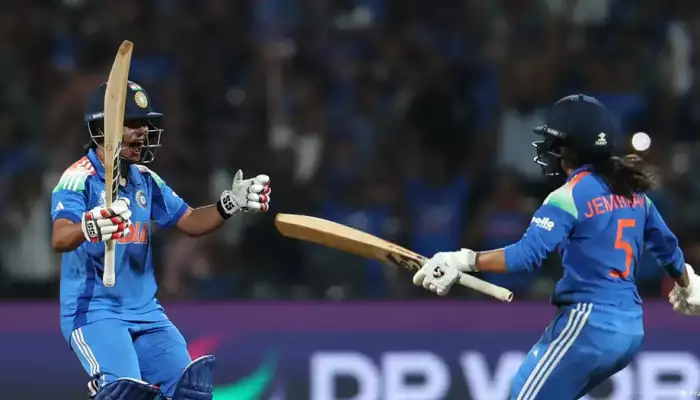
Apart from cricket,India has long been seen as an underachiever on the international sporting stage, as demonstrated by a 71st ranking in the 2024 Paris Olympics. However, a surge in the participation of women in a wide range of sports could help change this.
The number of registered women football players in India grew from 8,683 in 2016 to 37,829 last year. Participation in national javelin championships rose from 31 juniors in 2019 to 137, while in shooting, the number of female competitors jumped from 1,033 to 2,181 over the same period. At the Asian Games, women won just 36% of India's medals in 2002; by 2023, that share had climbed to 43%.
Taruka Srivastava, who represented India in tennis at the 2010 Asian Games, has witnessed these changes first hand.
"If you look at the Paris Olympics and the athletes that emerged in their sports, you will see more women than men," she told DW.
"When I look at the state of Uttar Pradesh where I come from, most of the top athletes are women."
Role models
As well as the cricket team that won the 2025 ICC World Cup and became household names, there are footballer Manisha Kalyan, and Olympic medallists such as Manu Bhaker (shooting), Mirabai Chanu (weightlifting), P.V. Sindhu (badminton) and Lovlina Borgohain (boxing) for aspiring athletes to look up to.
Annesha Ghosh, a Mumbai-based sports documentary-maker believes that Indian women are now benefiting from groundbreakers from an earlier generation.
"Women and athleticism were never part of a same sentence by default because the subcontinent has largely been run on patriarchal lines, but the arrival of female role models has made a difference," Ghosh told DW.
Ghosh added that even the cricket World Cup winners have cited badminton legend Saina Nehwal, who won bronze at the 2012 London Olympics, as an inspiration. There was also tennis star Sania Mirza, who won six major titles in a decade-long professional career.
"From a visual perspective, Mirza was breaking so many stereotypes, a woman – a Muslim woman – playing a sport and wearing a skirt. If you belong to certain communities, you are especially perceived a certain way, and Mirza had to contend with judgment on that front too," added Ghosh.
"She lived on her own terms on and off the court. She was a real badass. When I was growing up, I thought, 'who is this woman, dominating the court and taking on rubbish questions from journalists.'"
Media and perception
Stars like Mirza helped to change perceptions in the country.
"This is especially important in rural areas as most of the women who started their athletic journeys are from villages or small towns, not the major cities," Srivastava said.
In 2025, 852 league competitions across 15 sports disciplines took place through ASMITA, involving 70,000 female athletes, a rise of 17,000 from 2024.
"It's about breaking barriers," Raksha Khadse, minister of state for youth affairs and sports said of ASMITA.
"It is a powerful step towards affirmative action, bringing aspiring women players, including those from tribal and minority communities, right into the spotlight."
Srivastava is among those who credit the initiative with removing practical barriers.
"In the past, state tournaments were sometimes far away and hard to travel to, she said.
"There are now more tournaments for athletes to compete and more events in which to compete nearer to home."
One example from the world of entertainment has also been a factor. The 2016 movie "Dangal" told the story of the wrestling sisters Geeta and Babita Phogat. Geeta won gold at the 2010 Commonwealth games and Babita took silver. At the time, it was the highest-grossing film in Bollywood's history.
"Dangal was a huge success and played a big part in pushing women's sport into the mainstream, to become part of popular culture," said Ghosh.
"Story-telling is important and there were stories being told by Bollywood, which is huge in India."
2036 Olympic bid
Now the challenge for India is to maintain this momentum, according to Baljit Rihal, sports agent and founder of players agency Inventive Sports.
"The foundation is there," Rihal told DW.
"The key now is scale. If India wants this to become a lasting legacy rather than a moment in time, investment needs to increase significantly, particularly in facilities, coaching, long-term development and safeguarding."
The city of Ahmedabad is to host the 2030 Commonwealth Games and Prime Minister Modi hopes the capital of his home state of Gujarat will win the right to host the Summer Olympics six years later – something that would stand to benefit female athletes, not only through the construction of new facilities.
"You have to uphold Olympic values, do justice to what the Games stand for and the IOC (International Olympic Committee is big on gender equality," said Ghosh, before noting that the journey is long from over.
"Sport can be a soft power to the world and India is standing on a goldmine of potential talents."