Tuesday 13 / October / 2026
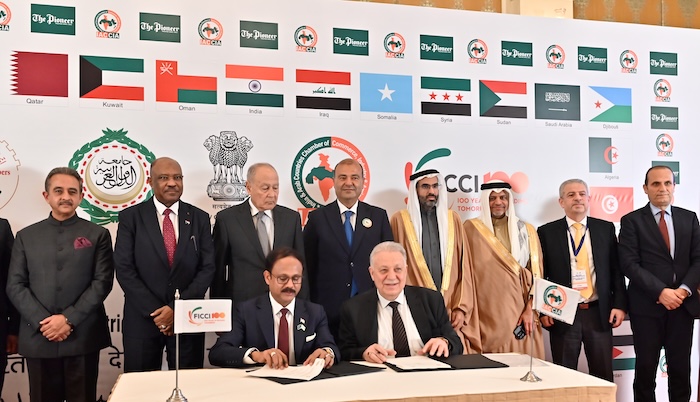
The inaugural ceremony of the India & Arab Countries Chamber of Commerce, Industry & Agriculture (IACCIA) marked a significant milestone in strengthening India-Arab economic and strategic cooperation. The event brought together senior leaders and dignitaries from India and the Arab world, underscoring centuries-old ties rooted in trade, culture & people-to-people connections.
Distinguished guests at the ceremony included H.E. Mr. Ahmed Aboul Gheit, Secretary General of the League of Arab States; H.E. Mr. Kirti Vardhan Singh, Minister of State for External Affairs and Minister of State for Environment, Forest and Climate Change, Government of India; and Dr. Khaled Mohamad Hanafy, Secretary General of the Union of Arab Chambers, along with visiting ministers and senior officials from Arab countries.
Speaking at the event, Dr. Siddeek Ahmed, Co-Chair, Arab Council, FICCI, and Chairman & Managing Director, ERAM Holdings, highlighted the depth and momentum of India-Arab relations, which has evolved into comprehensive partnerships spanning diplomacy, trade, investment, energy, infrastructure and strategic cooperation. Several Arab nations today share comprehensive strategic partnerships with India, supported by platforms such as the Arab-India Cooperation Forum and regular high-level engagements.
“India and the Arab world are entering a new phase of economic partnership - one driven by shared growth ambitions, strategic trust & long-term collaboration across trade, investment, energy, technology and skills,” said Dr. Siddeek Ahmed. “The launch of IACCIA is both timely and strategic, providing a strong institutional platform to translate our shared vision into tangible outcomes for businesses and economies on both sides.”
Recent developments reflect this growing momentum, including the visit of the President of the UAE to India, which further strengthened bilateral ties and led to a new agreement on defense cooperation. India is also hosting the 2nd India - Arab Foreign Ministers’ Meeting, reinforcing a shared commitment to regional stability and global cooperation.
Economic engagement between India and the Arab world continues to expand rapidly. Trade between India and the Gulf Cooperation Council (GCC) reached approximately US$ 180 billion in 2024-25, while total trade with Arab League countries stood at US$ 215 billion. Under the India-UAE CEPA, bilateral trade has crossed US$ 100 billion, with a target of US$ 200 billion by 2032. Saudi Arabia remains one of India’s largest trading partners with trade exceeding US$ 41 billion, while commerce with Oman and Qatar continues to grow through long-term energy agreements and new trade frameworks.
India’s non-oil exports to the Arab region - particularly electronics and engineering goods are rising steadily. Significant potential also exists in renewable energy, food security, advanced technology, logistics and resilient supply chains, aligned with major national development initiatives such as Viksit Bharat @2047, PM Gati Shakti, Saudi Vision 2030, Qatar National Vision 2030 and the UAE’s We the UAE 2031.
Beyond trade, India & Arab countries are deepening cooperation in space, infrastructure & energy. India and the UAE have recently agreed to jointly develop commercial launch facilities, while initiatives such as the India- Middle East-Europe Economic Corridor (IMEC) aim to enhance regional and global connectivity. The UAE has committed US$ 75 billion in infrastructure investments in India, and long-term energy agreements, including the 10-year HPCL-ADNOC LNG deal, reflect growing strategic alignment.
Investment flows from the Arab world into India remain robust. In 2024-25, India received US$ 81 billion in FDI, with the UAE ranking as India’s seventh-largest investor. Saudi Arabia has announced plans to invest US$ 100 billion, while Qatar has committed US$ 10 billion and established a new investment office in India. The India- UAE Bilateral Investment Treaty further strengthens investor confidence.
People-to-people ties remain a cornerstone of the relationship, with nearly 9 million Indians living and working across the Arab world, including 3.5 million in the UAE and 2.75 million in Saudi Arabia, contributing significantly to economic growth and cultural exchange.
Highlighting the role of the Indian-origin enterprises, ERAM Holdings showcased its cross-border presence across manufacturing, skills development, technology & travel management and event services, aligned with national initiatives such as Make in India, Saudi Vision 2030, and the UAE’s National In-Country Value Program.
On behalf of FICCI, Dr. Siddeek Ahmed reaffirmed the organization’s full support to IACCIA in advancing its objectives and recommended measures such as visa-on-arrival facilitation for Indian business delegations, which would further enhance trade and investment flows.
The address concluded with an invitation to the Global Economic Cooperation (GEC) 2026, scheduled to be held in Mumbai, India from 17–19 February 2026. Organized by the Ministry of External Affairs and the Government of Maharashtra, the invitation-only forum will bring together global political leaders, investors and business leaders, including participation from the Hon’ble Prime Minister of India, the External Affairs Minister, and other senior leaders, to shape the next chapter of India-Arab economic cooperation.