Sunday 11 / October / 2026
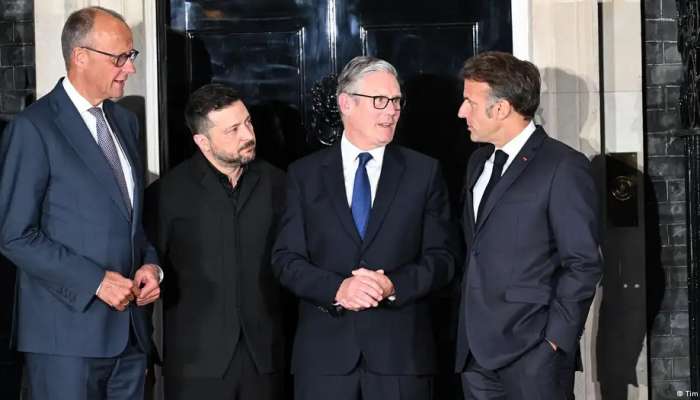
London: As Russia's full-scale invasion of Ukraine continues in its fifth year, British Prime Minister Keir Starmer hosted Ukraine's President Volodymyr Zelenskyy and European partners for talks on support for Kyiv.
German Chancellor Friedrich Merz and French President Emmanuel Macron were present at the meeting.
Together the three European leaders helm an informal security alliance known as the E3, which is one of Ukraine's main sources of international support.
In a joint statement, they extended their support to a proposal for a direct dialogue between Zelenskyy and Russian President Vladimir Putin — with US and European participation — to try to secure a ceasefire.
"Leaders commended President Zelenskyy's call for an end to the war, negotiated by diplomatic means, as set out in his letter to the president," the statement said, referring to an open letter Zelenskyy wrote to Putin last week, proposing a face-to-face meeting between the two.
The letter was snubbed by the Russian leader, who said the offer did not come across as sincere.
Putin said he saw "no point" in meeting Zelensky until a possible peace deal had been agreed.
Ukraine needs more missiles, Zelenskyy tells Starmer
Meanwhile, Zelenskyy — who joined the European leaders in Downing Street — said he told the UK's Starmer that Kyiv needed additional missiles for air defence systems.
"I informed Keir about the need for additional missiles for air defence systems and the things that are important for protecting energy infrastructure and preparing for winter," the Ukrainian leader wrote on X.
After Sunday's talks, Starmer, Merz and Macron stressed that Europe had a key role to play in any settlement as a firm supporter of Kyiv
The UK and France also lead the so-called "Coalition of the Willing" initiative to provide security guarantees for Ukraine as part of a peace process, while Germany gives the most support to Kyiv in absolute terms.
Russian drone hits nuclear-fuel storage facility
Before the talks, a Russian drone struck a storage facility for spent nuclear fuel near the disused Chernobyl (Chornobyl) plant, Ukrainian officials said on Sunday.
The UN's nuclear watchdog, the IAEA, said it had been informed of the attack and that radiation levels at the site had remained stable.
The facility is located around 15 kilometres (9 miles) from the Chernobyl plant, the site of the world's worst nuclear disaster in 1986.
The incident comes as British Prime Minister Keir Starmer is set to host the leaders of Ukraine, France and Germany to discuss ongoing support for Ukraine in its fight against the Russian full-scale invasion.
What do we know about the attack?
Kyiv's General Staff and the state atomic agency issued separate statements on the incident, saying a container-receiving building had been partially destroyed in the strike.
They said that the facility did not contain any spent fuel at the time of the attack.
A fire that broke out after the attack was successfully extinguished, with no injuries reported.
In a statement, the IAEA said a team would soon visit the site "to inspect the impact."
Ukrainian President Volodymyr Zelenskyy called the attack "an extremely vile Russian strike."
"Today, the Russians again struck the special territory around the Chornobyl Nuclear Power Plant. A 'shahed' hit one of the buildings of the Centralised Spent Fuel Storage Facility," he wrote on X, referring to a common Russian attack drone.
Ukrainian Foreign Minister Andrii Sybiha wrote on X that it was not the first time that Russia had put nuclear facilities in Ukraine at risk.
"Russia's nuclear blackmail and threats to nuclear safety are systemic, deliberate, and unacceptable," he wrote on X.
In February 2025, a containment arch over the damaged Chernobyl reactor was hit by a Russian drone in an attack denied by Moscow.
Both sides have also accused each other of attacking the Russian-occupied Zaporizhzhia Nuclear Power Plant in southeastern Ukraine.
Meanwhile on Monday, a Ukrainian drone strike on a passenger train killed one of its drivers and wounded another, a Moscow-backed official said.
"As a result of an enemy drone strike on the locomotive of a passenger train on the Moscow-Simferopol route, the driver has been wounded and the assistant driver killed, according to preliminary data," Sergey Aksyonov, the Moscow-installed head of the Crimea region, said in a post on Telegram.
He added that no passengers were harmed in the attack.