Wednesday 01 / July / 2026
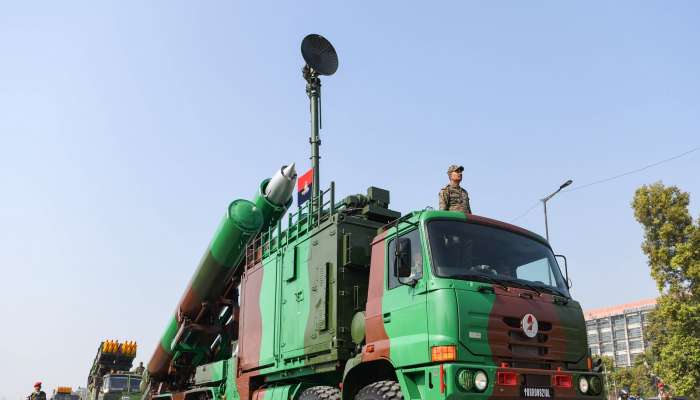
The United Arab Emirates is reportedly in discussions with India to acquire the BrahMos supersonic cruise missile and potentially the Akashteer air defence system, as Abu Dhabi accelerates defence modernization efforts following recent regional tensions involving Iran.
The BrahMos missile, jointly developed by India and Russia, remains one of the world's fastest operational cruise missiles, capable of sustained speeds of around Mach 2.8–3.0. Any export to the UAE would require Russian approval due to Moscow's role in the programme and the extensive use of Russian technology in its development.
Military analysts note that the BrahMos is heavily derived from Russia's P-800 Oniks cruise missile, inheriting key design features including its ramjet propulsion system, supersonic flight profile, aerodynamic configuration and launch architecture. The missile's ability to maintain high speeds throughout most of its flight makes interception significantly more challenging than with conventional subsonic cruise missiles.
A major advantage of the BrahMos in export markets is that it is produced in India rather than Russia, allowing countries aligned with Western partners to acquire a weapon system based on Russian technology without directly purchasing Russian arms. This has already enabled exports to countries such as the Philippines, which has faced political constraints on procuring military equipment directly from Moscow.
For the UAE, ground-launched BrahMos batteries could provide a powerful long-range precision strike capability against targets across the Gulf region, complementing existing air-launched weapons such as the SCALP cruise missile. While an air-launched BrahMos variant is operated by the Indian Air Force on Su-30MKI fighters, integration on the UAE's F-16E/F Desert Falcon and Mirage 2000-5 fleets would be difficult due to the missile's large size and weight.
The proposed package also includes discussions on the export of Akashteer, India's automated air-defence command-and-control system, according to a Reuters report published on June 22. While no agreement has been signed, officials say the talks remain at an early stage.
If finalised, the deal would represent another significant step in India's transition from being one of the world's largest arms importers to becoming a credible supplier of advanced military hardware.
"For India, this is a major confidence booster," said a defence analysy. "It accelerates the country's shift from being a top arms buyer to a growing exporter, strengthens ties with a key Gulf partner beyond oil and trade, and demonstrates that Indian defence systems are combat-proven and globally competitive."
He said the UAE is also believed to be interested in a wider range of Indian military equipment, including Akash surface-to-air missile systems, Pinaka multi-barrel rocket launchers, precision-guided munitions and unmanned aerial vehicles for possible naval and coastal defence roles.
Analysts believe a UAE purchase could have wider implications for India's defence industry by encouraging other Middle Eastern countries to explore Indian-made weapons and military systems.
"The UAE is a sophisticated defence buyer with access to the most advanced American and European weapons," he said.
India and the UAE have steadily expanded their strategic partnership in recent years, with defence cooperation now encompassing joint military exercises, cybersecurity, intelligence sharing and security collaboration.
"India has already generated interest in its artillery systems and ammunition in other international markets, and similar opportunities could emerge across the Gulf," he said.
He added that a broader defence agreement would benefit the UAE by diversifying its sources of military equipment, strengthening its protection against complex aerial threats and enhancing its strategic autonomy, while providing India with a valuable opportunity to expand its defence exports and deepen security ties with a key regional partner.