Saturday 19 / September / 2026
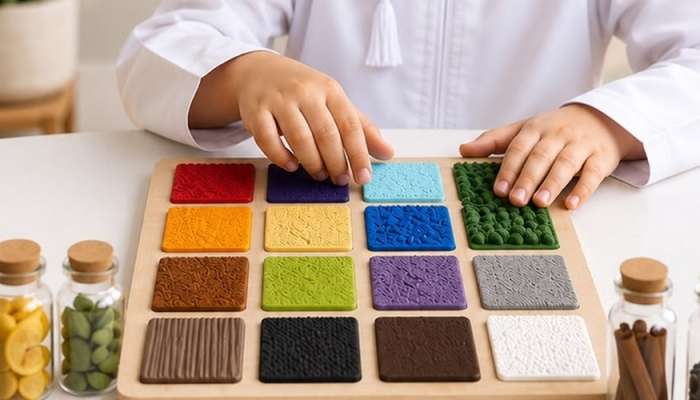
Muscat: Driven by her conviction that innovation begins with an idea that addresses a human need, Omani inventor Azza Mohammed Al Malki has developed an educational tool called “Sensory Colours” to help blind and visually impaired individuals recognise and understand colours through touch, smell and sound — expanding inclusive learning through innovative solutions.
“The initial spark came from my belief that creativity is a right for everyone, and that losing sight does not mean losing the ability to imagine or feel colours,” Al Malki told the Oman News Agency (ONA). She said the idea evolved from a human question into a real project, born from a genuine need in the community and a desire to make an impact that touches a group deserving to learn and create in ways that suit their sensory world.
The innovation has been recognised with several awards, including the Economic Vision Award in Social Responsibility and Sustainability from leading Arabic newspaper in Oman in 2025, and the Creativity and Excellence Award from a leading Omani magazine — motivating further development and transformation into a sustainable initiative.
She explained that colours are linked to textures, scents, sounds and environmental associations, enabling a blind person to form a mental and emotional image of each hue. When a child touches or smells a colour, they begin to build associations that help them understand and interact with it in a way closer to their daily experience — making learning more inclusive, engaging and humane.
She pointed out that materials were chosen with great care: safe, eco‑friendly and sensory, with different textures to distinguish between colours and non‑toxic dyes suitable for children. The focus was on enhancing each colour’s sensory experience clearly and comfortably.
She added that the innovation helps blind individuals form a mental and emotional image of colours through other senses, opening space for imagination, creativity and expression. The integration of senses significantly enhances memory, as the mind interacts more strongly with information linked to emotions and sensory experiences.
“When a colour is associated with a familiar scent or special texture, it becomes easier and deeper to remember than a purely theoretical description,” Al Malki said. “This creates a beautiful emotional relationship between the blind person and the world, giving them a greater sense of inclusion, confidence and the ability to express themselves.”
She explained that sensory colours can be used in schools and rehabilitation centres, not only for teaching colours but also for developing sensory skills, enhancing communication and stimulating artistic creativity. Global studies have shown that using touch, sound and scents helps visually impaired individuals understand and interact with colours more deeply.
She said that the innovation can also be applied in art therapy, drawing activities and classroom exercises, helping students express themselves and build confidence. Teachers and rehabilitation specialists can use it to develop more inclusive methods that consider diverse learning needs.
She pointed out that challenges included providing safe, high‑quality materials that combine sensory and educational aspects, adapting the product for different age groups and degrees of impairment, raising awareness about sensory education, and establishing partnerships with schools and rehabilitation centres.
Al Malki noted that modern technologies such as artificial intelligence and smart applications could further enhance the innovation, offering a more advanced educational experience. Global research is increasingly moving towards multisensory systems to help visually impaired individuals understand colours and arts more comprehensively.
She explained that the innovation could be extended to raised drawing, sensory stories, interactive exhibitions and educational tools based on different senses. It could also be applied in music, theatre and interactive arts, linking colours to emotions, sounds and textures for an integrated artistic experience. Specialised training programmes and workshops could help blind individuals discover their talents and participate more fully in creative fields.
She concluded that this innovation gives blind individuals a greater opportunity to interact with daily details linked to colours, arts, emotions and the environment. When colour becomes a tangible experience, a blind person feels closer to understanding the world around them — enhancing their sense of inclusion, independence and self‑confidence, and opening the door to artistic expression and creative participation.