Wednesday 16 / September / 2026
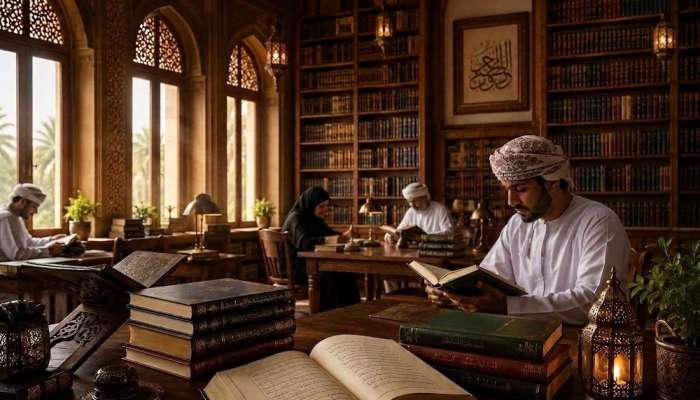
Muscat: The essence of the classical Omani poem today is embodied as one of the most prominent features of the cultural landscape in the Sultanate of Oman, stemming from the aesthetic and linguistic legacy it has established, which reflects human experience and historical richness through the ages.
Currently, the classical poem is witnessing a tangible upward evolution regarding its linguistic context and artistic style, as it has become more conscious and capable of expressing human issues and intersecting with cultural transformations.
In this context, a detailed perspective emerges on the reality of the language of the classical poem, examining its Omani identity and its contexts of renewal.
Khamis bin Qalam Al Hinai, a poet, pointed to what the "poem" has built regarding its own language in a way that reflects its cultural identity, establishing a distinctive presence in the Arab poetic scene while continuing renewal and preserving authenticity and beauty. He stated that poetry—as he sees it—is a delving into the interior and an exposure to the exterior, and that the Omani poet, like other poets, seeks in his poem to fuse time and space with the fire of his words, connecting with history and geography to the extent that he disconnects from them.
He added that the Omani poet contributes to extending human emotional experience through leveraging personal experiences and surroundings to evoke wonder at times and empathy at others when read by people wherever they may be, using a tongue saturated with the flavors of language without losing the unique accent acquired through upbringing and connection.
He emphasised that over the past year, he had the opportunity to examine young works by an elite group of male and female poets, finding in them a human extension evident in both form and content.
For his part, poet Younis Marhoon Al Busaidi discussed innovation, artistic aesthetics, and the key features of renewal in the classical Omani poem today, touching upon the experiences that must craft the poem to make it more astonishing. He said: "I currently do not find in the Omani poetic text—or perhaps even the Arab text, speaking of metered poetry, whether classical vertical or free verse—any innovation or broader horizons, despite openness to new experiences. The reason is that even if a poet tries experimenting with dictionaries, they will face the obstacle of using a new image to which the recipient is unaccustomed, causing it to be perceived as insufficiently rhetorical. Moreover, changing the vocabulary is neither the crux nor the pillar of innovation."
Al Busaidi added in his personal view that innovation lies in treatment, style, and diversifying methods. He noted that the Omani metered text has been unable to leave its own distinct fingerprint; when reading it, one cannot distinguish whether the poet is Omani or from outside the geographical area to which he originally belongs, making it similar to poetic texts from any other Arabic-speaking nation—or even non-Arabic speaking if the poet is there.
He concluded that regarding the innovation demanded of the poet, the poet must respond by asking: What is the required innovation in a poem? Looking back at history, radical transformations in vertical text consisted of departing from the classical opening of weeping over ruins—the darkness of which Abu Nuwas broke—along with moving from the vertical structure to Muwashah poetry and changing rhymes, and finally to Taf'ilah (monometer) poetry. All these transformations in the body of the poem are essentially insufficient, as they did not lead to addressing the intended subject. Nevertheless, he noted that a poet should not be burdened beyond capacity, and the honor of trying is enough.
In the same context, poet Abdullah Ahmed Al Kaabi says: "To me, the features of renewal in the Omani poem seem to rest on two things: first, creative innovation stemming from the intermingling of literary arts, and second, nostalgia for the eloquence of the ancient past."
Al Kaabi added: "Accordingly, features emerged in the Omani poem, including openness to the intermingling of literary arts among poets possessing full mastery of their poetic, expressive, and linguistic tools, alongside the adherence of vertical and Taf'ilah poets to ready-made, coined expressions without adding anything new. These two features necessarily lead either to constructing a poetic language with high poetic density and rhythmic clamor that conceals the inability to innovate ideas or creative imagery, or to constructing a poetic language with subtle resonance and a flexible rhythm harmonizing with the language of daily life."
He believes that the poem transcending literary genres and borders, which truly carries the concept of a creative text, is the one inspired by daily language and the language of literature aligning with human issues; such a modernist text explodes with numerous meanings and mountains of wonder.
He emphasised that this interactive text, which relies on the reader co-creating with the author, is the most important. Here arises the question: Can the Omani poem be unique in presence and innovation? The reader themselves answers this, as this textual uniqueness must be accompanied by a reader who is creative in reading and analysis, and indeed in constructing a new text shared with the original author.
Meanwhile, poet Dr. Aisha Abdullah Al Fazari touched upon the assets possessed by the Omani poem to enhance its presence on literary platforms, events, and Arab awards, while opening up to broader segments of readers. She discussed mechanisms for leveraging the cultural and creative momentum in the Sultanate of Oman to build a new phase that makes the classical Omani poem more impactful, widespread, and capable of producing a poetic achievement keeping pace with the future.
She stated: "The Omani poem possesses solid assets qualifying it to enhance its presence in the Arab literary scene. It rests on an ancient poetic heritage and a cultural environment historically known for celebrating knowledge, language, and literature. Moreover, over recent decades, it has managed to move from narrow locality to broader horizons through poetic voices possessing artistic tools and intellectual vision."
She pointed out that the first of these assets is Omani cultural identity, as it is unique in its ability to draw inspiration from history, the sea, the mountains, the desert, and the Omani individual without falling captive to rigid heritage discourse. Instead, it reformulates these elements within a contemporary vision that transforms the Omani location into an open human space capable of addressing the Arab reader wherever they are.
Al Fazari also added: "The Omani poem possesses a linguistic and aesthetic capital characterized by combining correct Arabic with rich poetic imagery, accompanied by a clear inclination among many poets toward linguistic economy, avoiding rhetoric, and opening up to symbolism, mythology, intertextuality, and human knowledge, which makes it more adaptable for presence in the modern Arab poetic scene."
She noted that among the most important strength factors of the classical Omani poem is the presence of a diverse generation of poets. The Omani poetic scene does not rely solely on established names, but witnesses a growing presence of young voices writing vertical, Taf'ilah (monometer), and prose poetry, giving the experience vitality and continuity and creating a dialogue between generations instead of a disconnect.
She emphasised that textual quality alone is no longer sufficient to guarantee widespread reach. The contemporary Arab cultural scene is governed by an integrated system comprising media, translation, publishing, digital platforms, awards, festivals, and literary criticism.
Therefore, enhancing the presence of the Omani poem requires working across several parallel tracks. The first track is promoting translation; the Omani poem possesses human themes capable of reaching a global audience, yet it still requires institutional projects to translate poetic anthologies into living languages, opening new horizons outside the Arab framework.
She explained that the second track lies in media and digital presence, as the ways poetry is received have changed, with many readers discovering poems through digital platforms, podcasts, short films, and recorded poetry evenings. Investing in professional digital content and producing visual and audio material to accompany poetry will grant it wider dissemination among younger generations.
Poet Al Fazari said: "Following that is activating participation in Arab and international awards and forums, as these platforms are no longer mere competitions, but have become tools for building cultural reputation and introducing new experiences to readers and critics. The wider the participation of Omani poets in festivals and forums, the greater the presence of the Omani poem in the Arab consciousness. Furthermore, the critical movement represents an essential element in establishing literary standing; distinguished texts require academic studies, critical readings, university theses, and specialized conferences, because criticism transforms individual experience into a recognized literary phenomenon. This aspect still requires greater attention from universities, research centers, and cultural journals. It is also important to invest in Arab cultural partnerships through publishing joint poetic anthologies, organizing forums that bring together Omani poets with their Arab counterparts, and establishing literary residence programs to facilitate the exchange of expertise and broaden the circle of reception."
Dr. Aisha addressed the cultural movement witnessed in the Sultanate of Oman today, describing it as an exceptional opportunity to build a new phase for the Omani poem. She said: "Cultural institutions, festivals, book fairs, literary forums, and youth initiatives all form a fertile environment for creating a renewed poetic project."
She added that if this momentum is utilized within a strategic vision, it can elevate the poem from mere local presence to broad Arab influence. Among the most prominent efforts for the coming phase are launching national projects to document and digitise Omani poetry and make it available across modern platforms; supporting young poetic talent through training programmes, writing workshops, and critical supervision; enhancing poetry's presence in schools, universities, and public spaces to cultivate a new reader base; producing visual and audio poetic content leveraging digital technologies and artificial intelligence without compromising the essence of the text; encouraging publishing houses to issue qualitative poetic anthologies and expand their distribution across the Arab world; and building bridges with Arab and international cultural institutions to establish joint poetic projects.
She stressed that the future of the Omani poem will not be built on conservation alone, nor on unrestrained experimentation, but on achieving a precise balance combining authenticity and renewal. A poem that preserves its linguistic and cultural identity while simultaneously opening up to major human questions is the most capable of survival and impact.
She explained that the classical Omani poem stands today before a historic opportunity; it possesses language, talent, heritage, and cultural environment, and what it needs is an integrated project that enhances its presence across the Arab world and globally.
Meanwhile, poet Ali Hamid Al Alawi addressed the evolution of intellectual visions and topics covered by the classical Omani poem, making it closer to human beings and their issues, and more open to cultural and human questions, highlighting the spaces it still holds to offer new insights reflecting the uniqueness of the Omani experience while engaging with the Arab poetic scene. He said: "There is a tangible development in the classical Omani poem, highlighted through the transition from the 'event poem' that merely conveys external events to the 'vision poem' concerned with contemporary human anxiety and various issues. This transition has allowed it to transcend traditional themes and direct instructional discourse, opening up to existential, cultural, and cosmic questions to center around humans and their diverse concerns."
He added that the classical Omani poem managed to absorb the rapid social transformations affecting current civil society values. It also underwent development in artistic structure and expressive tools in keeping with modern Arab poetry. Thus, Omani poets ventured into the realm of prose poetry in a manner allowing the text to be open to interpretation without canceling poetry's communicative function or excluding the recipient from the equation. Omani poets also excelled in Taf'ilah (monometer) poetry with merit and competence, while maintaining traditional Arabic metered achievements.
Al Alawi emphasised that critical studies and poetic competitions—such as festivals, forums, and literary gatherings—play a pioneering role in enriching this poetic renewal and establishing common ground between authenticity and modernity.
In his remarks, he pointed to the rich spaces possessed by the classical Omani poem for renewal, interaction with the Arab poetic scene, and contribution to shaping modern Arab identity through reproducing and employing heritage in classical poetry. This includes drawing inspiration from rich Omani nature vocabulary, Omani maritime history, and legends, projecting them onto modern human anxiety and alienation.
Furthermore, employing local colloquial vocabulary within classical text grants it distinctiveness and uniqueness. Additionally, giving voice to spatial memory in a modernist style through invoking elements of Omani nature—such as forts, castles, frankincense, and palm trees—transforms them into philosophical and existential symbols. The Omani poetic experience can also be deepened using Arab prose poetry techniques to engage with contemporary life issues and embody Omani emotional self-expression, producing poetic work worthy of circulation among readers and capable of drawing the attention of Arab literary criticism.