Tuesday 27 / October / 2026
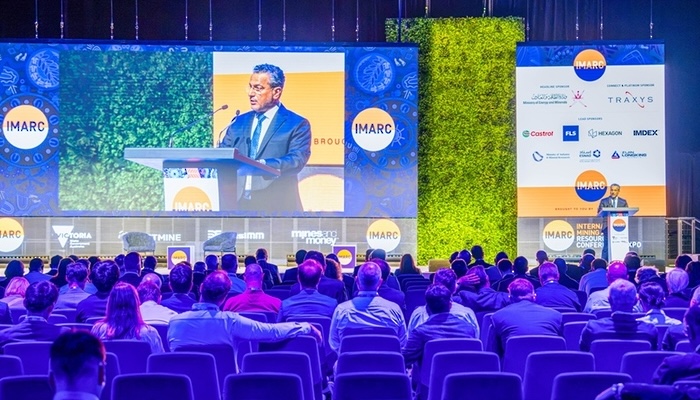
Muscat: The Ministry of Energy and Minerals launched three new mining concession areas, totaling 2,062 square kilometers, during its participation in the International Mining and Resources Conference and Exhibition, which began in Sydney, Australia, and will continue for three days. This initiative aims to expand investment opportunities in the minerals sector in the Sultanate of Oman, attract companies specializing in exploration and mining, and support the development of new mining projects.
Through its participation in the conference and exhibition, alongside six companies operating in the minerals sector, the Ministry aims to showcase the mineral potential of the Sultanate of Oman and the investment opportunities available at various stages of mining activity, from exploration and resource evaluation and mine development to ore processing and manufacturing.
The Ministry also seeks to expand cooperation with Australian and international companies in advanced mining technologies and enhance the participation of Omani companies and small and medium-sized enterprises (SMEs) in projects and services related to the sector. This will support its growth, enhance its competitiveness, and boost local content, in line with the objectives of Oman Vision 2040.
The areas offered include Concession Area (25-C), spanning 627 square kilometers, where preliminary geological data indicates the potential presence of manganese, nickel, and laterite ores, Concession Area (25-F), covering 830 square kilometers, with its most prominent potential ores being manganese, nickel, and laterite and Concession Area (22-C), covering 605 square kilometers, which includes geological indicators of copper, chromite, and gold, as well as marble and basalt. These three areas offer qualified local and international companies opportunities to conduct exploration programs, geological surveys, and mineral resource assessments, paving the way for the development of future mining projects based on the results of technical and economic studies.
His Excellency Mohsen bin Hamad Al-Hadhrami, Undersecretary of the Ministry of Energy and Minerals, affirmed that the Sultanate of Oman's participation in this international event reflects its commitment to enhancing the contribution of the minerals sector to economic diversification and transitioning from resource exploration and extraction to developing an integrated mining industry based on investment, modern technologies, and specialized expertise.
His Excellency explained that mineral resources alone do not create prosperity. Their economic benefits are realized when integrated with investment, knowledge, and modern technologies, transforming into productive projects, competitive industries, and sustainable opportunities. This contributes to achieving the goals of Oman Vision 2040 and enhancing local content.
His Excellency called upon international companies and investors to explore these opportunities and build long-term partnerships that contribute to developing mineral resources, transferring knowledge and technologies, and enhancing the competitiveness of the Omani mining sector.
He noted that the Ministry is working in parallel to develop the regulatory and investment environment, streamline procedures, and expand digital services to facilitate the transition of projects from exploration and evaluation to development and production, while adhering to environmental standards and occupational health and safety requirements, developing national expertise, and promoting the participation of small and medium-sized enterprises.
The Sultanate of Oman boasts a diverse geological landscape and numerous mineral resources, some dating back approximately 900 million years. Among its most prominent geological features is the Samail Ophiolite, considered one of the world's most important geological outcrops of the oceanic crust and upper mantle. Oman's mineral resources and indicators include copper, chromium, gold, nickel, manganese, zinc, lead, gypsum, limestone, dolomite, marble, silica, silica sand, gabbro, basalt, quartzite, clay, and salts. These resources vary between those currently being commercially exploited and those undergoing exploration and evaluation, offering diverse opportunities for developing related projects and industries.
The Sultanate of Oman's pavilion at the exhibition showcases available concession areas, existing projects, and investment services. It provides investors and international companies with direct access to representatives from the Ministry and participating companies. Details regarding opportunities and application requirements are available through the Ministry of Energy and Minerals' "Taqah" platform.
Over the past five years, Oman’s mining sector has witnessed significant progress in developing its investment and regulatory framework. 28 mining concessions have been granted for the exploration and development of diverse minerals, alongside improvements to regulatory frameworks, the adoption of an occupational health and safety manual, and the establishment of the Oman Minerals Trading Company to regulate mineral trading and marketing. These development efforts have included expanding the digitization of services, enabling applications, tracking, and access to investment opportunities through the “Taqah” platform, thereby enhancing transparency and the efficiency of concession management.
In terms of economic performance, the sector’s revenues grew by 39 percent in 2025 compared to 2024, coinciding with the expansion of mining activities, the commissioning of copper production projects, and the advancement of several concession areas towards development and production. The Mazoon Copper Mine project is considered a promising development that will support production and enhance mining-related activities and services in the coming phase.