Sunday 01 / November / 2026
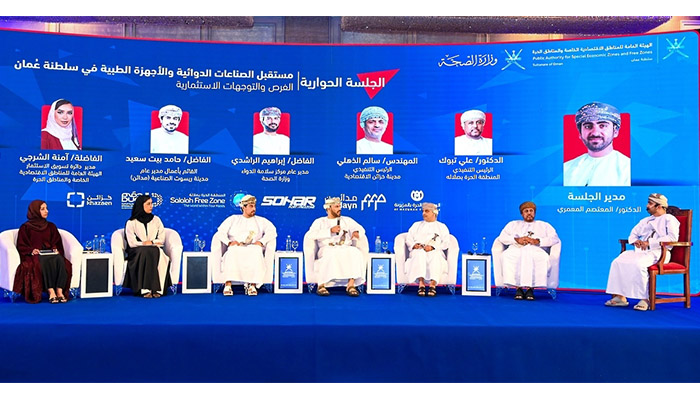
Salalah: The Public Authority for Special Economic Zones and Free Zones (OPAZ) announced the details of specialised industrial clusters for pharmaceutical industries and medical devices in the economic, free, and industrial zones under its supervision, in a step aimed at enhancing national drug security, attracting qualitative investments, and localising medical and pharmaceutical industries in the Sultanate of Oman.
The announcement came during a meeting held in Salalah, Dhofar Governorate, under the auspices of Dr. Hilal Ali Al Sabti, Minister of Health, in the presence of Qais Mohammed Al Yousef, Chairman of the Public Authority for Special Economic Zones and Free Zones, along with several officials, private sector representatives, and investors in the health sector.
OPAZ explained that the first phase of the industrial clusters extends over a total area of 1.5 million square metres, distributed equally among the Salalah Free Zone, Raysut Industrial City, and Khazaen Economic City, at 500,000 square metres each.
Incentives offered to investors include customs exemptions on the import of equipment, machinery, and raw materials, financial and tax exemptions for up to 30 years, land usufruct rights for up to 50 years, 100 percent foreign ownership, alongside operational facilities, freedom of capital and profit transfer, export support incentives, as well as financial and credit facilities.
Qais Mohammed Al Yousef emphasised that establishing these clusters comes in implementation of the Royal approval of His Majesty Sultan Haitham bin Tarik for the proposal to establish specialised economic clusters for pharmaceutical and medical device industries, noting that it represents a step toward building an integrated industrial base that meets local market needs and opens broader horizons for export.
He explained that the integration among economic, free, and industrial zones allows investors to benefit from the infrastructure, logistical services, and competitive advantages of each zone, while enhancing partnerships between manufacturers, raw material suppliers, and service providers, thereby contributing to connecting value chains and raising the competitiveness of Omani products.
Dr. Hilal Ali Al Sabti, Minister of Health, affirmed that developing specialised clusters for pharmaceutical and medical device industries represents an important step toward enhancing health security by developing national production capacities, diversifying supply sources, and localising specialised technologies and knowledge, supporting the sustainable availability and quality of pharmaceutical and medical products.
He pointed out the importance of building industrial and technical partnerships, developing national competencies in production, quality assurance, research, and development, and directing investments toward priority health needs.
Data revealed that the value of the Sultanate of Oman's exports of medicines and medical products reached approximately OMR26.5 million in 2025, while imports of healthcare products recorded around OMR345.2 million in 2024, compared to approximately OMR287.1 million in 2020, representing an increase of nearly 20 percent.
The number of existing medical factories in the Sultanate of Oman stands at 20 factories, including seven pharmaceutical factories, two factories for pharmaceutical raw materials, and 11 factories for medical supplies, alongside 18 industrial projects currently in construction and execution phases.
The meeting witnessed Khazaen Economic City signing four investment agreements in the pharmaceutical industries and medical services sector, with a total value of OMR20 million, spanning an area exceeding 52,000 square metres, to establish three pharmaceutical factories and a specialized center for storing medical products, devices, and supplies.
The agreements include establishing a factory for Al Badr Trading and Industry Company to produce pharmaceutical tablets and capsules with an investment of OMR7 million, a factory for Lama Pharmaceutical Company to produce drugs for immune diseases, cancer, and anesthetics with an investment of OMR6 million, alongside a factory for Al Mansoor Pharmaceutical Factory Company to produce human medicines and vitamins with an investment of OMR5 million.
The agreements also encompass establishing a specialised pharmaceutical center affiliated with the National Pharmacy to store medical products, devices, and supplies, with an investment of OMR2 million over an estimated area of nearly 29,000 square metres.
Eng. Salim Sulaiman Al Dhuhli, CEO of Khazaen Economic City, stated that the four agreements reinforce the city's position within the system of specialised industrial clusters, explaining that total actual investment agreements in the city reached 18 agreements, with an investment value of nearly OMR250 million.
He added that the new projects contribute to diversifying the production of specialised medicines and providing medical storage services, enhancing the integration of value chains and raising supply efficiency for the health sector.
In Salalah Free Zone, two memorandums of understanding (MoUs) were signed to develop specialised industrial projects. The first was signed with Apex Trans Gulf Manufacturing to establish two projects for manufacturing medical laryngoscopes and producing non-woven fabrics for medical uses, with proposed investments amounting to OMR30.76 million over a total area reaching 50,000 square metres.
The second MoU relates to Aram Pharmaceuticals to establish a project specialised in secondary packaging of pharmaceutical products.
Dr. Ali Mohammed Tabuk, CEO of Salalah Free Zone, stated that the two MoUs represent a step toward diversifying medical industries and supporting activities, noting that the zone is working with partners to complete project development requirements and leverage Salalah's strategic location and connectivity to global markets.
He added that the proposed projects would support medical supply chains and enhance opportunities for establishing a specialised industrial cluster for pharmaceutical and medical industries in Salalah Free Zone.
These projects reflect the Sultanate of Oman's direction toward developing the pharmaceutical and medical device industry sector, enhancing public-private partnerships, and attracting local and foreign investments, thereby supporting economic diversification, raising in-country value, and opening new horizons for Omani products in regional and international markets.




