Sunday 01 / November / 2026
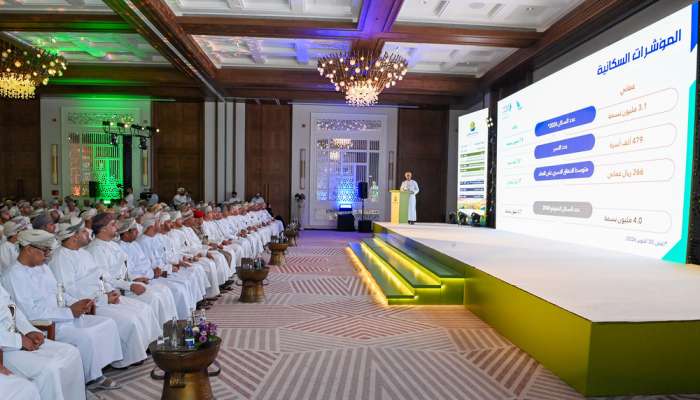
Muscat: The activities of the Food Security Lab 2026 launched today in Muscat under the theme "Localising the Second Billion."
The event is organised by the Ministry of Agriculture, Fisheries and Water Resources. It centers on five strategic pillars aimed at enhancing investments, utilising artificial intelligence, and empowering food security sectors to raise local production and develop manufacturing industries, in support of achieving the target of localising the second billion.
The organization of the lab, held under the auspices of Sheikh Ghuson Hilal Al Alawi, Chairman of the State Financial and Administrative Audit Authority, comes within national efforts aimed at strengthening the food security system in the Sultanate of Oman, stimulating local and foreign investments, and deploying modern technologies and artificial intelligence to boost local production and empower manufacturing industries, contributing to achieving the targets of Oman Vision 2040 and localizing the second billion.
Dr. Yousuf Mohammed Al Riyami, Director General of Statistics at the National Centre for Statistics and Information, presented a visual display in which he explained that household expenditure on food during 2025 accounted for 24.4 percent of total household expenditure, with an average monthly expenditure of OMR 194.5 per household. Meanwhile, the average Omani household expenditure reached OMR265.6, compared to OMR86.9 for expatriate households.
He indicated that meat and poultry constituted the largest share of household food expenditure at 22.8 percent, followed by vegetables and fruits at 18.5 percent, then restaurant meals at 11.8 percent, and grains and bread at 11.6 percent, while fish and seafood accounted for 7.5 percent.
He stated that the value of available food in the Sultanate of Oman during 2025 reached approximately OMR5.2 billion, including OMR2.9 billion from local production and OMR2.3 billion from imports, while the value of domestic food consumption's share reached OMR4.2 billion.
He pointed out that 2025 data indicates that the value of imports of food industries and beverage products reached approximately OMR 1.447 billion, while the value of imports of agriculture and livestock production products reached OMR885 million, and the value of imports of fishing activity products reached OMR15 million.
Regarding economic contribution, he mentioned that the value added of the food sector to the Gross Domestic Product rose from OMR1.416 billion in 2024 to OMR1.555 billion in 2025, recording a growth rate of 9.8 percent. The value added during the same year was distributed across agriculture and livestock production at approximately OMR624 million with a growth rate of 6.1 percent, fishing activity at approximately OMR572 million with a growth rate of 19.7 percent, and food industries and beverages activity at approximately OMR359 million. Additionally, the value added of the water sector reached approximately OMR455 million, recording a growth rate of 4.8 percent compared to 2024.
For her part, Eng. Asma Hamoud Al Hinai, Director of the Oman Vision 2040 Implementation Follow-up Office at the Ministry of Agriculture, Fisheries and Water Resources, reviewed the efforts of food security labs in localising the second billion and achieving the targets of Oman Vision 2040 during the 10th Five-Year Plan (2021–2025). She explained that it yielded 493 projects with an investment value exceedingOMR1.8 billion, along with 105 enabling initiatives.
She noted that total investment projects in food security sectors for this year up to October 2026 reached approximately 252 projects, with a total investment value of OMR 662.74 million, distributed across four main sectors. The water resources sector accounted for 44 projects valued at OMR383.13 million, and the livestock sector accounted for 51 projects valued at OMR 162.72 million, while the number of fisheries sector projects reached 64 projects valued at OMR75.35 million, and the plant resources sector accounted for 93 projects valued at OMR41.54 million.
She stated that the Food Security Lab 2026 focuses on five strategic pillars. The first pillar, "Muthmir" (Fruitful), focuses on enhancing food security and achieving the targets of "Oman Vision 2040" by stimulating local and foreign investment across various food security sectors, contributing to expanding the investment base and enhancing production capabilities.
The second pillar, "Mumakkin" (Enabler), focuses on developing initiatives supporting the sector's sustainability and qualifying national cadres in alignment with its future needs and directions, thereby enhancing the readiness of national competencies to keep pace with development requirements in food security sectors. The third pillar, "Mukhattiti" (Planner), is concerned with aligning future directions with the 11th Five-Year Plan, ensuring the integration of priorities and initiatives with national development plans.
Meanwhile, the fourth pillar, "Mubtakir" (Innovator), focuses on enhancing the use of artificial intelligence in food security sectors to boost production, improve operational efficiency, and ensure the sustainability of resources and production. The fifth pillar, "Mu'azziz" (Enhancer), aims to empower manufacturing industries by activating strategic partnerships and applied research, supporting the development of value-added chains and maximizing the utilization of local products.
The lab's launch ceremony included the inauguration of the Electronic Agricultural, Fisheries, and Water Census, as digital transformation represents a primary driver for developing institutional work and an effective tool for elevating data efficiency and decision accuracy.
The "Story of a Drop" campaign was also launched, aimed at promoting preventive behaviors related to drinking water safety, raising awareness about the importance of periodic water source testing, proper storage of bottled water, and protecting wells and tanks from pollution sources, contributing to public health protection, enhancing water security, and achieving the targets of Oman Vision 2040. Additionally, the visual identity of Omani Aflaj was launched, in a step highlighting this national legacy as a symbol of cultural identity and an enduring Omani school in resource management and sustainability.