Sunday 29 / November / 2026
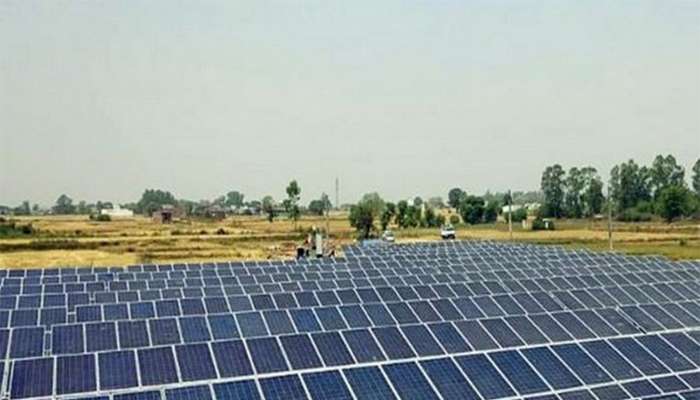
New Delhi: The image of an Indian farmer standing in a field has long been associated with food production, the monsoon's rhythm, and the hard work of cultivation. A new possibility is taking shape across the country: the same farmer could also become a clean-energy producer.
With solar panels powering irrigation, generating additional income and, in some models, sharing agricultural land with crops, India is exploring a new relationship between farming and energy.
The idea is captured in an emerging national ambition to transform Annadatas — providers of food — into Urjadatas, or providers of energy. It is not simply about installing solar panels in rural areas. It is about making agriculture a participant in India’s clean-energy transition while retaining its central role in feeding the nation.
The growing policy focus on agrivoltaics, solar irrigation and decentralised renewable power suggests that this transition is moving from concept to implementation.
A new agricultural landscape
One of the most promising developments is agrivoltaics, a system that combines agricultural production and solar electricity generation on the same land.
Instead of replacing farmland with conventional solar installations, agrivoltaic projects use elevated or suitably spaced solar panels that allow crops to grow underneath or between them.
The approach offers a different way to think about land use. Solar panels generate electricity while the land continues to support cultivation, provided the design, crop selection and local conditions are appropriate.
Depending on the system, partial shade can also influence soil moisture, crop temperatures and water requirements.
India hosted the 7th Agrivoltaics World Conference at Bharat Mandapam in New Delhi from 21 to 23 October 2026, bringing the subject into sharper national and international focus.
The event brought together policymakers, researchers and industry representatives to examine how solar generation and agriculture can operate together.
The Union Agriculture Minister, Shivraj Singh Chouhan, highlighted the importance of developing agrivoltaic models suited to India's small and marginal farmers.
He also underlined the role of the Indian Council of Agricultural Research in building scientific evidence and identifying suitable crop combinations across the country's 15 agro-climatic zones.
PM-KUSUM drives change
The clearest expression of India's solar-powered agricultural transition is the Pradhan Mantri Kisan Urja Suraksha evam Utthaan Mahabhiyan, or PM-KUSUM.
Launched in 2019, the programme seeks to expand solar energy in agriculture through decentralised power plants, standalone solar irrigation pumps and the solarisation of existing grid-connected agricultural pumps.
Its design gives farmers more than one way to participate in the energy economy. They can use solar pumps to irrigate their fields, generate electricity through decentralised plants and, where arrangements permit, sell surplus power to distribution companies.
The model is intended to provide daytime electricity for irrigation, reduce dependence on diesel and create an additional source of income.
The programme has a central financial support allocation of approximately US$3.74 billion (Rs 34,422 crore) and aims to add around 34,800 MW of solar capacity by 2026-27.
According to the Ministry of New and Renewable Energy, by 30 September 2026, nearly 1.91 million off-grid solar pumps had been installed, more than 1.71 million agricultural pumps had been covered through feeder-level solarisation, and around 2,426 MW of decentralised solar capacity had been commissioned on farmers' land.
The government reported that more than 2.17 million farmers had benefited by the end of 2025.
These figures illustrate how solar power is becoming part of agricultural infrastructure rather than remaining confined to large renewable-energy parks.
PM-KUSUM 2.0 takes shape
The next phase could give agrivoltaics a more prominent place in the national programme.
At the Agrivoltaics World Conference in October, New and Renewable Energy Secretary Santosh Kumar Sarangi told Mint that the government planned to add approximately 5 GW of agrivoltaic capacity over three years under PM-KUSUM 2.0.
The proposed approach is intended to support dual-use solar installations while addressing the additional cost of elevated structures required for cultivation beneath panels.
Sarangi said the government was considering a mechanism to neutralise around 25 percent of the additional installation cost, bringing the effective tariff closer to that of conventional ground-mounted solar projects.
The proposal would mark an important policy step: recognising that solar installations designed to preserve agricultural activity require a different approach from conventional solar parks.
The emphasis on small and marginal farmers, cooperatives, panchayats and Farmer Producer Organisations could also widen participation beyond large landholders.
At the conference's September curtain-raiser, Union Minister Pralhad Joshi had already indicated that the next phase of PM-KUSUM would include a dedicated agrivoltaics component.
He stressed that farmers should retain ownership of their land while gaining the opportunity to earn from electricity generation.
Solar irrigation changes farming
Solar-powered irrigation is another important part of this transition. For farmers, access to dependable electricity is closely linked to the timing and quantity of irrigation.
Solar pumps can provide daytime power directly from sunlight, while solarised grid-connected systems can allow farmers to use electricity for cultivation and potentially feed surplus generation into the grid.
The Council on Energy, Environment and Water (CEEW), in its research on solar-powered plants and grid-connected pumps, examined how PM-KUSUM's decentralised generation and pump-solarisation models could turn farmers into energy producers.
Its analysis highlighted the potential for distribution companies to procure locally generated renewable electricity while farmers receive an additional income stream.
The benefits can extend beyond irrigation. Reliable local solar power can support rural enterprises and agricultural value chains, including cold storage, food processing, grain drying and milk chilling.
Such facilities can help preserve produce, improve handling and create opportunities for value addition closer to farms.
Food and energy together
Agrivoltaics brings a wider dimension to the idea of solar farming. In suitable locations, elevated panels can allow crops to grow underneath or between rows, creating a shared space for food and electricity production.
The choice of crops and panel configuration is central to the model, as different plants require different levels of sunlight.
India's varied agro-climatic conditions make region-specific research particularly important. A crop combination suited to one part of the country may not be appropriate elsewhere.
This is why the collaboration between the Agriculture Ministry, the Ministry of New and Renewable Energy and ICAR is significant. Scientific crop mapping and field trials can help identify suitable systems for different regions and farming practices.
The international conference in New Delhi, attended by more than 1,500 participants from over 40 countries, including around 400 farmers, reflected growing interest in this integrated approach.
Its theme, Powering the Global South, placed India's agrivoltaics ambitions within a wider conversation about food security, renewable energy and rural development.
A wider solar momentum
The agricultural transition is gathering pace alongside India's broader solar expansion. The government reported that India added 44.61 GW of solar capacity in the financial year 2025-26.
Distributed solar solutions contributed 16.3 GW, accounting for 36 percent of that addition. PM-KUSUM alone contributed 7.6 GW, according to the Ministry of New and Renewable Energy's November 2026 update.
This growth provides a wider foundation for rural solarisation, supported by expanding domestic manufacturing, renewable-energy infrastructure and policy initiatives. The potential of agrivoltaics lies in connecting these developments directly with agricultural livelihoods.
Prime Minister Narendra Modi has also highlighted the role of solar energy, natural farming and technology in shaping the future of Indian agriculture. The broader vision places clean energy alongside improvements in cultivation practices and the use of modern technology to strengthen rural productivity.
The transformation from Annadata to Urjadata does not redefine the farmer's primary role; it expands the possibilities attached to it. A field can continue to produce food while contributing electricity to the grid.
A solar pump can irrigate crops while reducing reliance on conventional power. And a farmer can participate in the renewable-energy economy without necessarily stepping away from cultivation.
India's next agricultural revolution may be measured not only in tonnes of grain or improvements in crop productivity, but also in the electricity generated across its villages.
By bringing sunlight into the heart of farming, the country is exploring a model in which food security and energy security can advance together.