Saturday 26 / September / 2026
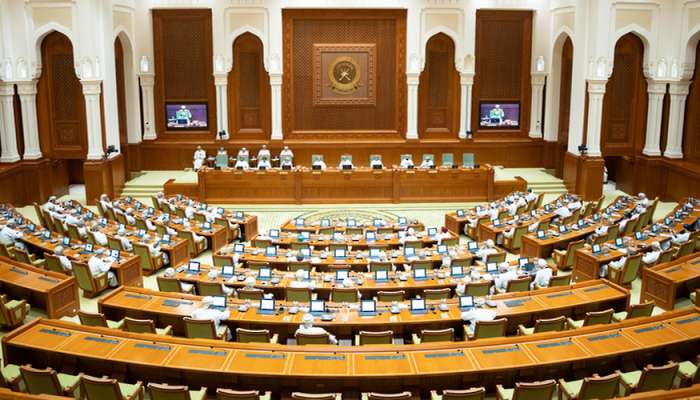
Muscat: The members of the Shura Council today listened to statements from both Sultan bin Salim Al Habsi, Minister of Finance, and Dr. Said bin Mohammed Al Saqri, Minister of Economy, regarding the Draft State General Budget for 2026 and the Eleventh Five-Year Development Plan (2026-2030). This took place in a closed session as stipulated by Article (52) of the Oman Council Law.
This occurred during the Council's third regular session of the third ordinary convening (2025-2026) of the tenth term (2023-2027), which was held under the chairmanship of Khalid bin Hilal Al Maawali, of the Chairman of the Council, and in the presence of Sheikh Ahmed bin Mohammed Al Nadabi, Secretary-General of the Council and members of the council.
Sultan bin Salim Al Habsi, Minister of Finance, delivered the Ministry's statement on the Draft State General Budget for the Fiscal Year 2026, reviewing some positive economic indicators achieved in the national economy in recent years. He explained that the economic policies adopted by the government contributed to enhancing levels of financial stability and raising the efficiency of public financial resource management, which reflected in the improvement of the Sultanate of Oman's credit rating and a significant decrease in public debt levels compared to previous years.
He pointed out that the structural reforms and fiscal balance programs contributed to strengthening international confidence in the Sultanate of Oman's economy and opened wider horizons for attracting foreign investments.
The Minister of Finance also reviewed the foundations and pillars upon which the State General Budget for 2026 was based, including estimates of public revenues, public spending, public debt management, the estimated oil barrel price in the budget, deficit and financing, and inflation rates. He highlighted development and investment spending for 2026. The discussion also touched upon the most prominent financial, economic, and monetary indicators for 2025, as well as the main potential economic and financial risks during 2026.
He added that the estimates of the State General Budget for 2026 took into account providing coverage and social protection for various segments of society, maintaining the level of spending on essential services such as education, health, and housing, and stimulating the national economy by promoting the growth of companies and projects that support economic diversification activities and operations.
During today's session, the Council members also listened to the statement of the Minister of Economy regarding the Eleventh Five-Year Development Plan (2026-2030), which addressed the main themes of the project, the methodology for preparing the plan, its main features, the priorities of economic sectors, and development projects. The financial and economic framework of the plan and its key strategic programs, in line with the goals and priorities of Oman Vision 2040, were also discussed.
The statement by the Minister of Economy indicated that the plan aims to build a sustainable developmental economy by promoting economic diversification. It also seeks to transition towards clean energy and promote a low-carbon economy by increasing reliance on renewable energy projects and developing policies that incentivize investment in green hydrogen and alternative energy-related industries. Furthermore, it aims to enhance economic decentralization for the governorates, raise the efficiency of the labor market and employment, sustainable social development, and enhance governance and institutional efficiency.
He added that the methodology for preparing the Eleventh Five-Year Plan (2026-2030) was based on a comprehensive evaluation of the performance of the Tenth Plan (2021-2025), and an examination of growth indicators in various sectors, including developing the investment environment, employment programs, expanding economic infrastructure, and improving legislation regulating economic activity, among other sectors.
For their part, the Council members presented their inquiries and observations regarding the Draft General Budget for 2026 and the Eleventh Five-Year Development Plan (2026-2030). Their discussions focused on financial policies and the fundamentals and assumptions relied upon when preparing the Draft State General Budget for the Fiscal Year 2026, enabling it to deal with oil prices and global changes, thereby ensuring financial, economic, and social stability.
Discussions also revolved around the priorities of developmental projects, global economic developments and their reflection on the economic and social situation in the Sultanate of Oman. Emphasis was placed on the importance of expanding the benefits of the social protection system, intensifying efforts to employ national cadres and empowering them through training in various sectors, in addition to addressing the situation of those who lost their jobs.
The discussions stressed the importance of focusing on economic diversification in various sectors, including manufacturing, tourism, the digital economy, and the mining, agricultural, and fisheries sectors.
The report of the Economic and Financial Committee on the Draft State General Budget for the Fiscal Year 2026 was discussed and approved. The Committee had diligently studied the draft budget by holding a number of meetings and gatherings, and hosting specialists in various related sectors. It concluded with the preparation of a comprehensive report on the financial and economic indicators, data, and forecasts, including recommendations that support national directions in line with the objectives of the Eleventh Five-Year Development Plan and Oman Vision 2040.
The session also included briefing on a number of draft laws referred by the government, including the Draft Unified Law for International Land Transport among GCC States, and the Draft Amendment of Some Provisions of the Personal Data Protection Law.
It is worth noting that the Council will hold its fourth regular session tomorrow, Tuesday, which will be dedicated to discussing and approving the Draft Law on Sports Entities.