Friday 23 / October / 2026
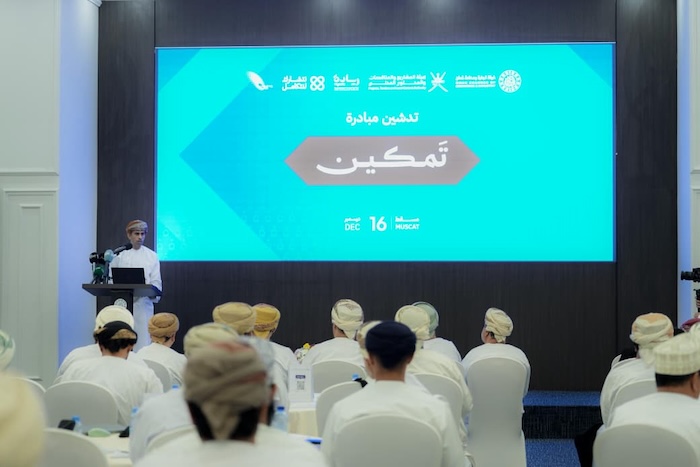
Muscat: The Oman Chamber of Commerce and Industry (OCCI) today (16 December) launched the “Tamkeen” initiative, in cooperation with the Oman Vision 2040 Implementation Follow-up Unit, the Projects, Tenders and Local Content Authority, and the SMEs Development Authority (Riyada). The launch took place in the presence of H.E. Sheikh Faisal bin Abdullah Al Rawas, Chairman of the Board of Directors of the Oman Chamber of Commerce and Industry, H.E. Eng. Badr bin Salim Al Maamari, Chairman of the Projects, Tenders and Local Content Authority, a number of OCCI Board members, and business owners, at the Chamber’s headquarters in Muscat Governorate.
The initiative is one of the most prominent outcomes of the developmental workshop on the strategic directions of the Oman Chamber of Commerce and Industry to serve the private sector. These directions focus on three main pillars: improving the business environment, expanding the base of economic diversification, and strengthening partnership in the economic development of the governorates.
The initiative seeks to implement two training programmes during 2025 and 2026 across various governorates of the Sultanate of Oman, with the aim of qualifying small and medium enterprises (SMEs) and enhancing their ability to benefit from the 10% share allocated to them from government procurement and tenders, in a manner that strengthens their participation in national projects and supports their economic growth and expansion.
Empowering the Private Sector
H.E. Sheikh Faisal bin Abdullah Al Rawas, Chairman of the Board of Directors of the Oman Chamber of Commerce and Industry, stated that the initiative represents an important step within the Chamber’s ongoing efforts to empower the private sector and enhance its readiness to compete in a business environment that is witnessing rapid development in its tools and requirements. He added that the effective participation of small and medium enterprises in the government procurement system and national projects has become a fundamental pillar for their growth and business sustainability.
H.E. Al Rawas explained that the Chamber recognises the importance of enhancing the capabilities of business owners and SMEs as a direct investment in the future of the national economy. Accordingly, the Chamber is keen to provide specialised training programmes that address the real challenges companies face when entering the tendering market. This programme equips participants with practical expertise based on best practices, thereby enhancing their ability to submit more competitive and high-quality bids.
He further noted that the cooperation between the Chamber and supporting entities in implementing this initiative represents a practical model of partnership between government institutions and the private sector. Such cooperation contributes positively to developing the business environment, increasing transparency, and expanding the base of companies benefiting from available government opportunities. He stressed that enabling companies to access these opportunities in a fair and effective manner contributes to creating added economic value and supports Oman Vision 2040 objectives related to enhancing local content and diversifying sources of income.
H.E. Al Rawas expressed his hope that the programme would open new horizons for SMEs and serve as a catalyst for improving their administrative and technical practices and benefiting from digital platforms. He called on all companies and entrepreneurs to continue building their capabilities and upgrading their tools in line with future requirements.
Institutional Integration
H.E. Eng. Badr bin Salim Al Maamari, Chairman of the Projects, Tenders and Local Content Authority, stated that the “Tamkeen” initiative represents a practical model of institutional integration between public and private entities, contributing to enhancing SME readiness and enabling them to compete effectively within the government projects and procurement system.
He noted that the Authority’s role in the “Tamkeen” initiative focuses on enabling national enterprises to understand tendering mechanisms, registration and classification requirements, and bid preparation in line with best practices. This ensures fair competition and transparent procedures, while helping SMEs benefit from the allocated share in government procurement and tenders and achieve greater presence in national projects.
Qualitative Initiatives
For his part, Zakariya bin Abdullah Al Saadi, Chief Executive Officer of the Oman Chamber of Commerce and Industry, stated that the “Tamkeen” initiative is one of the most prominent outcomes of the developmental workshop on the Chamber’s strategic directions, which are based on three main pillars: improving the business environment, expanding the base of economic diversification, and strengthening partnership in the economic development of the governorates.
He noted that in February of this year, the Chamber launched, in cooperation with the Oman Vision 2040 Implementation Follow-up Unit, 14 qualitative initiatives that contribute to achieving these strategic directions and form part of the Chamber’s ongoing efforts to support the private sector and enhance its role in the national economy.
Al Saadi explained that the Chamber, in cooperation with the Oman Vision 2040 Implementation Follow-up Unit, has developed detailed plans to implement these initiatives in a manner that ensures the desired impact, using a clear methodology aimed at strengthening the Chamber’s role in serving the private sector. He said that today’s announcement, in cooperation with partners from the Projects, Tenders and Local Content Authority and the SMEs Development Authority (Riyada), marks the start of implementation of one of the most important initiatives, the “Tamkeen” initiative.
He added that the importance of this initiative stems from the firm belief that SMEs are not merely a supporting component of the national economy, but a key driver of development, a broad field for innovation and new solution development, an important source of job creation for youth, and an active contributor to enhancing local content and supporting national supply chains. From this perspective, the Chamber is working to enhance SME readiness and enable them to enter major national projects with confidence and efficiency, ensuring a greater role in creating added value and achieving sustainable economic growth.
Implementing the Tamkeen Initiative
Ghazi bin Said Al Hamar, Officer in Charge of Implementing the Tamkeen Initiative at the Oman Chamber of Commerce and Industry, delivered a visual presentation on the initiative and its role in enhancing local content and sustainable investment. This is achieved through cooperation with relevant entities to increase SME utilisation of the 10% share allocated to them from government procurement and tenders, with the aim of achieving economic sustainability, supporting national industries, and increasing SME participation in national projects.
He noted that the initiative seeks to strengthen the role of enterprises in supporting the national economy, enhance the efficiency of local content and increase its contribution to national projects, and achieve sustainable development through income diversification and support for entrepreneurship.
Al Hamar affirmed that the expected outcomes of the initiative include enhancing enterprise readiness to compete in government tenders, increasing SME participation within the allocated 10% share, strengthening local content and increasing the contribution of national enterprises to supply chains, improving bid quality and tender success rates, and empowering entrepreneurs while building networks with supporting entities.
“Esnad” Platform
Khalid bin Juma Al Shukaili from the Projects, Tenders and Local Content Authority delivered a visual presentation on the “Esnad” platform, noting that it is an electronic service for managing government tenders. The platform supports higher efficiency in tender issuance, evaluation, and award through electronic systems, thereby enhancing transparency and accuracy.
The platform is a key enabler in supporting SMEs and Riyada cardholders through clear policies, including allocating 10% of government procurement and tenders directly to SMEs, allocating at least 10% through subcontracting via the main contractor, and reserving tenders valued at no more than OMR 25,000 for SMEs. Al Shukaili confirmed that the number of SMEs registered on the Esnad platform has exceeded 5,000 companies.
He also outlined the platform’s content and services, as well as registration procedures, stressing the importance of completing company profiles to ensure service continuity and data updates. He further highlighted policies and enablers supporting SMEs holding the Riyada card.
Launch of the Training Programme
Meanwhile, the Chamber, in cooperation with supporting entities, began today, Tuesday 16 December, the implementation of the first training programme under the Tamkeen initiative at its headquarters in Muscat Governorate. Abdulaziz Al Darmaki and Nabila Al Amriya from the Projects, Tenders and Local Content Authority presented a working paper on bid preparation mechanisms for government procurement and tenders in line with best practices. Mazen Al Maamari from the Authority delivered a working paper on company registration and classification on the Esnad platform.
The initiative will continue delivering training programmes across all governorates of the Sultanate of Oman, starting in South Al Batinah Governorate on 17 December, followed by Al Dakhiliyah on 18 December, Al Wusta on 21 December, Al Dhahirah on 24 December, and Al Buraimi on 25 December. This will be followed by North Al Sharqiyah on 28 December, Musandam on 1 January, Dhofar on 4 January, and South Al Sharqiyah o