Wednesday 30 / September / 2026
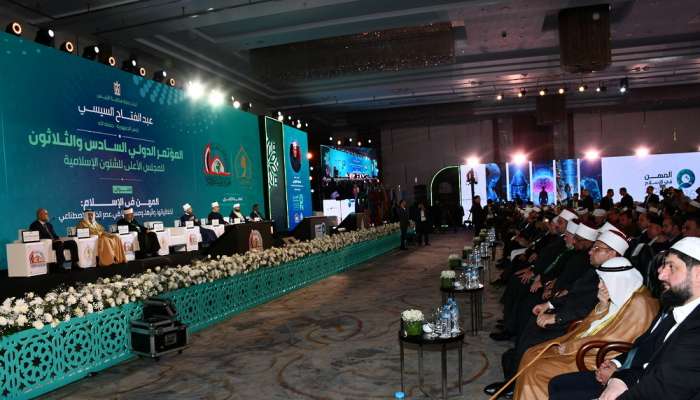
Cairo: The Sultanate of Oman, represented by the Ministry of Endowments and Religious Affairs, participated in the 36th International Conference of the Supreme Council for Islamic Affairs, hosted by the Arab Republic of Egypt.
The Omani delegation was led by Dr. Mohammed Said Al Maamari, Minister of Endowments and Religious Affairs.
In his address to the conference, the Minister emphasised the depth of fraternal ties between the two nations and commended Egypt’s consistent commitment to hosting discussions on Islamic issues and fostering joint Islamic action. He noted that the conference is being held at a critical juncture in human history, marked by accelerating technological transformations, evolving labour patterns, and the intertwining of ethical questions with the requirements of development and progress.
He stated that the choice of the conference theme reflects a deep awareness of the challenges facing contemporary societies, particularly regarding the ethics and future of professions amidst the growing reliance on Artificial Intelligence (AI). He pointed out that the digital revolution has led to rapid shifts in the concepts of work and production, impacting the tools, values, standards, and overall effect of professions on individuals and society.
He explained that the core challenge lies in preserving the essence of professions and safeguarding the status of the human being within new work systems. This ensures that technology remains a means of progress rather than a factor that threatens social balance, weakens justice, or hollows out the spirit and value of work.
The Minister noted that the Islamic perspective views work as a "trust and responsibility" (Amanah) before it is seen as a job or a means of production. He stressed that this vision has never been confined to its time but possesses the flexibility to provide inspiration across different eras, especially in an age of rapid transitions in tools and contexts.
He remarked that civilization is not measured by the power of means alone, but by the integrity of practice—the ethics of the physician, the honesty of the businessperson, the integrity of the judge, the precision of the craftsman, and the responsibility of everyone performing their duties. He noted that current technological shifts, led by AI, necessitate a re-evaluation of work tools and pose a deeper question regarding who will lead the course of labor in the future.
He further stated that the real danger does not lie in the development of technology itself, but in the decline of the human ethical role and the transformation of a profession from a mission and a responsibility into a mere soulless function. He emphasised that true progress is measured not only by technical speed but by the ability of societies to govern this progress with values that enhance, rather than diminish, the human presence. He stressed the need for a balanced discourse that combines keeping pace with development with a commitment to values, reinforcing the principle that AI—regardless of its capabilities—remains a tool, while moral responsibility remains an irretrievable human duty.
He called upon religious and scientific institutions to contribute actively to this global discussion by providing responsible visions that bolster professional ethics, keep pace with contemporary transformations, and contribute to formulating labor policies that preserve human dignity and achieve social balance.
He highlighted the experience of the Sultanate of Oman in this field, specifically in instilling values within the workplace. He described this as a key pillar for sustainable development, building trust, and achieving a balance between technical progress and the human dimension.
The Minister of Endowments and Religious Affairs concluded by stating that this conference, with its scientific themes and international experiences, represents a genuine opportunity to launch an enduring intellectual and ethical path. He noted that its impact will be reflected in technical societies, educational curricula, and labour policies to serve future generations, adding that a profession is not only what we do with our hands, but the impact we leave on the lives of others.