Thursday 01 / October / 2026
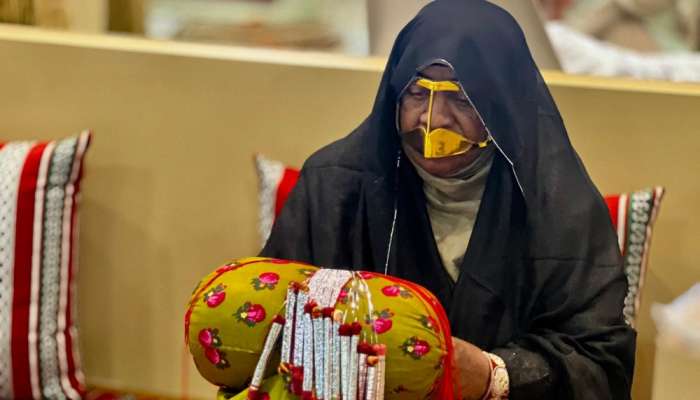
Muscat: 'Al-Badla' is one of the most distinctive decorative elements of traditional women’s dress in Al-Dhahirah Governorate, representing an aesthetic feature and an authentic expression of Omani heritage identity.
The craft reflects refined social taste and the creativity of Omani women, with craftswoman Marhoona bint Rashid Al-Aziziyah standing out for her mastery of weaving Al-Badla, drawing inspiration from Omani nature and Islamic decorative motifs.
Al-Aziziyah told the Oman News Agency that Al-Badla evolved over time from being part of daily wear into a symbol of identity and social distinction. It later became an essential ornament for women’s attire on formal occasions such as Eid celebrations and weddings, and was historically associated with women of high social standing.
With the passage of time and the interaction of customs, Al-Badla transcended its decorative role to become a source of pride reflecting cultural identity and social belonging. The continuity of its hand-weaving across generations further strengthened this connection, making it an embodiment of Omani values and aesthetic sensibilities.
She explained that her journey with this craft began at the age of fourteen, describing Al-Badla as a composition of coloured cotton and metallic threads woven into decorative embroidery used to adorn various parts of traditional garments. The craft requires exceptional manual skill, precision, and patience.
Al-Aziziyah elaborated on the visual form of Al-Badla, noting that it is created through intricate interlacing of cotton and metallic threads that form a clear visual language.
Wide stitches reflect simplicity of life, while dense stitches indicate focus and precision. Approximately 40 cotton threads are used, chosen for their strength and durability, with traditional colours such as red, white, and black selected for their vibrancy and ability to highlight the embroidery.
Silver threads, numbering around 14, are interwoven with the cotton threads and symbolise luxury and value. Their distinctive shine draws attention and represents light, hope, and joy, while also reflecting the Omani environment. She noted that silver threads retain their lustre over time, reinforcing the concept of authenticity.
She added that the size and density of the embroidery vary according to demand and traditionally indicate a woman’s wealth and social status, with larger and denser designs symbolising higher standing.
Wearing Al-Badla is reserved for major occasions, and its design is arranged in a balanced and harmonious manner based on the variation, density, and classification of threads.
Al-Aziziyah emphasised the historical role of Omani women in preserving, transmitting, and exchanging heritage across generations.
Through this craft, women document social experiences and values, including patience, endurance, and attention to detail, as producing a single piece can take more than two months of continuous manual work.
She pointed out that traditional dress reflects society’s aesthetic vision through balance, colour harmony, and rhythmic repetition.
The time-intensive process required to complete Al-Badla highlights its artistic value and the precision and sustained effort needed to shape each piece.
Regarding challenges facing the craft, she explained that the limited availability and high cost of raw materials pose significant obstacles, forcing some craftswomen to use lower-quality alternatives that threaten the authenticity of the craft.
She stressed the need to raise awareness of the cultural value of traditional crafts, as treating them merely as decorative items undermines their role as carriers of heritage.
She also called for the establishment of training programmes, educational workshops, and subsidised access to quality materials to ensure the continuity of the craft, noting that the declining number of skilled practitioners contributes to its gradual disappearance.
On the symbolic meanings embodied in Al-Badla, Al-Aziziyah explained that its patterns reflect identity, belonging, and elements of the natural environment. Zigzag lines represent mountains, symbolising strength and stability, while palm-inspired motifs express continuity and generosity.
She noted that silver threads, locally known as “Al-Khaws,” further reinforce the connection between society and the palm tree, a symbol of sustained giving in Omani culture.
She also highlighted the influence of Islamic architecture on Al-Badla designs, with decorative units such as columns, repeating patterns, and the central “house” motif forming the core design, bordered by tower-like elements. These symbols reflect harmony, order, and coexistence with the surrounding environment.
Al-Aziziyah affirmed that Al-Badla is capable of adapting to modern fashion trends while preserving its essence. By maintaining its geometric rhythm and hand-crafted execution, the Badla can be incorporated into contemporary clothing and abayas, with adjustments to size, placement, and colour to suit modern tastes and younger generations. This adaptation, she said, ensures that Al-Badla remains a living heritage passed on through generations.
She concluded by stressing that Al-Badla is not merely an aesthetic element, but a cultural legacy that reflects the ingenuity of Omani artisans and their ability to preserve heritage despite evolving fashion trends, reaffirming its status as a symbol of authentic Omani identity.