Monday 19 / October / 2026
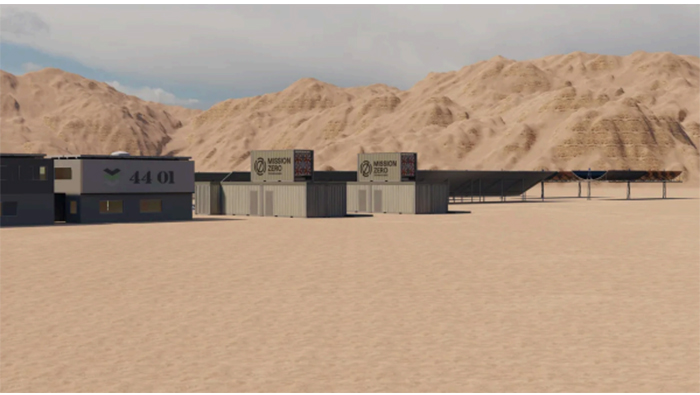
Somewhere in the Hajar Mountains, carbon dioxide is turning to stone. Not over centuries. In less than a year.
This is carbon mineralisation. Certain rocks react naturally with CO2, locking the gas permanently inside their mineral structure. This is not storage in the way most people imagine it, carbon pumped underground and monitored anxiously for leaks. This is elimination. The CO2 becomes rock. It cannot escape. It is gone.
The rock that does this best is called peridotite. It forms deep in the Earth's mantle and rarely surfaces. But in northern Oman, a geological accident 96 million years ago pushed a massive slab of ancient ocean floor onto dry land. The result is the Samail Ophiolite, the largest exposed body of peridotite on Earth, stretching approximately 500 kilometres across the Hajar Mountains. Through nothing more than rainwater and natural chemistry, these mountains quietly absorb around 100,000 tonnes of CO2 on their own every year.
Scientists have studied this for decades. Columbia University's Peter Kelemen has shown that if the natural process can be accelerated a millionfold through engineering, a single cubic kilometre of this rock could absorb a billion tonnes of CO2 per year.
That acceleration is what 44.01 is working on. The Omani startup, named after the molecular weight of carbon dioxide, dissolves captured CO2 in water and injects it into peridotite deep underground, where it turns to rock permanently. An independent life cycle assessment found the company delivers a carbon removal efficiency of 88 to 91 percent across its entire supply chain.
The results are striking. In a 2024 pilot with Abu Dhabi National Oil Company in Fujairah, 44.01 mineralised 10 tonnes of CO2 in under 100 days. The two companies are now scaling toward 300 tonnes. Back home, 44.01 and Oman's Ministry of Energy and Minerals have
signed a concession for the world's first commercial-scale peridotite mineralisation project, at Al Qabil in the Hajar Mountains.
What makes it particularly significant is how it solves two of the hardest problems in climate tech at once. Direct air capture, or DAC, pulls CO2 straight from the open atmosphere using industrial machinery. It works, but it needs somewhere permanent to put what it catches.
44.01 and Aircapture have joined forces on exactly this in the Hajar Mountains, with Aircapture's modular units capable of delivering up to 500 tonnes of liquid CO2 per year into 44.01's rock. Climeworks, whose Mammoth facility in Iceland is currently the world's largest
DAC plant, has also partnered with 44.01 on storage projects in Oman.
The UAE pilot showed something else. It was the first mineralisation project to run entirely on off-grid renewable energy, combining solar panels with battery storage, in partnership with Masdar. Solar-powered capture feeding into ancient rock is exactly what Oman's
geography makes possible at scale.
The world cannot reach net zero through emissions cuts alone. Oman, it turns out, may be the best address on Earth to fix that.
* The author is a student at the British School Muscat and writes on technology