Thursday 03 / September / 2026
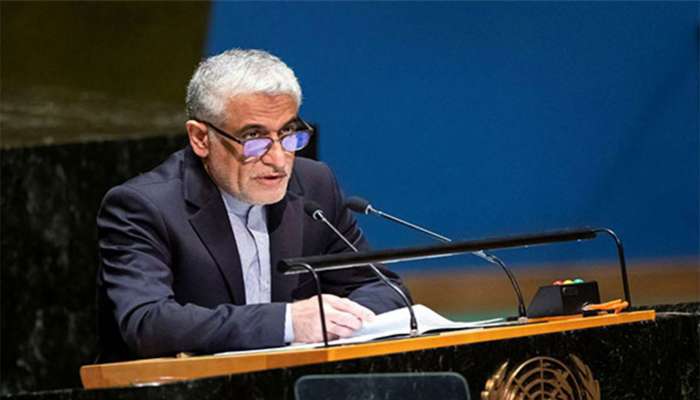
New York: Iran's permanent representative to the United Nations has formally expressed regret over the Security Council's decision to adopt a resolution against the Islamic Republic, according to reports by state broadcaster Press TV.
Amir-Saeid Iravani, speaking at a Security Council session on Wednesday, dismissed the document as "unjust and unlawful." He argued that the resolution's passage marks a "serious setback to the Security Council's credibility" and leaves a "lasting stain on the world body's record."
The envoy claimed the move was a "blatant misuse of the Security Council's mandate" intended to serve the "political agendas of certain members." He further suggested the text "distorts the realities on the ground" while failing to address the fundamental origins of the current regional crisis.
In a strongly worded address, Iravani condemned the "biased and politically motivated" nature of the document. He alleged that it "reverses the roles of victim and aggressor" and argued that the international response "emboldens both regimes to commit further crimes."
Official statements from the mission emphasised that Tehran would not acknowledge the Council's decision. Iravani described the action as "inconsistent with the United Nations Charter and international law," noting it "completely disregards the established principles governing the determination of acts of aggression."
The Iranian diplomat also directed sharp criticism toward European members of the Council. He claimed their support for the resolution proved their "claims of defending the UN Charter and international law are nothing more than empty words."
"Their hypocritical and irresponsible conduct once again demonstrates that political considerations take precedence over their professed commitment to international law," Iravani stated. He further alleged that these nations were merely "implementing political instructions from Washington" rather than acting independently.
The Iranian envoy, as cited in diplomatic transcripts, accused specific members of a "cynical and blatant attempt to blame Iran" while ignoring the actions of the US and Israel. He specifically referenced the "massacre of 170 schoolgirls in the city of Minab" as an example of overlooked atrocities.
According to Iravani, the conflict escalated following an "illegal, illegitimate, and unprovoked" military strike on 28 February. He linked this to the "cowardly terrorist assassination" of the Leader of the Islamic Republic, Ayatollah Seyyed Ali Khamenei, and other high-ranking officials.
The military campaign reportedly involved "coordinated attacks on both military and civilian infrastructure." Iravani noted that schools, hospitals, and residential buildings were targeted, resulting in the deaths of over 1,348 civilians and injuring more than 17,000 others.
Defending Tehran's military response, the ambassador asserted that Iran acted under its "inherent right to self-defense in accordance with Article 51 of the UN Charter." He maintained that this was necessary to protect national sovereignty after the Security Council failed to "discharge its duties."
Iravani also raised concerns regarding the "aggressors' use of the territories of certain third states" to facilitate attacks. He clarified that Iran's subsequent operations against bases in West Asia were "in no way against the sovereignty and territorial integrity of the regional countries."
In his remarks, the envoy insisted that Iran "will never abandon its rights under international law" regarding its vital interests. He called on the Security Council to force the US and Israel to "immediately cease all military attacks" and be held to "full accountability" for violations of international humanitarian law.