Thursday 27 / August / 2026
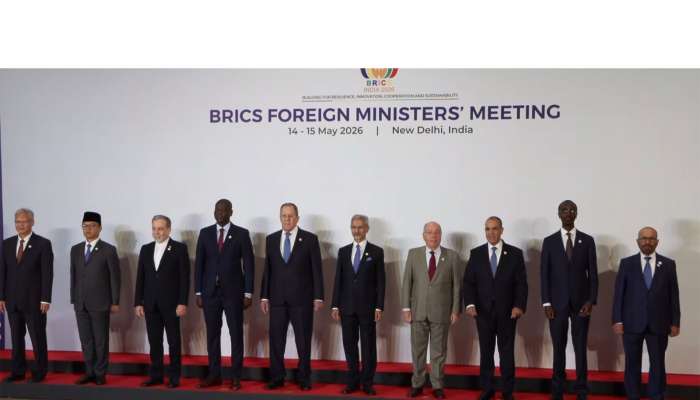
New Delhi: External Affairs Minister S Jaishankar on Thursday joined Russian Foreign Minister Sergey Lavrov, Iranian Foreign Minister Abbas Araghchi, Indonesian Foreign Minister Sugiono and other senior leaders for a family photo during the BRICS Foreign Ministers' Meeting at Bharat Mandapam.
The gathering brought together foreign ministers and representatives from BRICS member countries and partner nations to discuss key global and regional issues, including economic cooperation, multilateral engagement and international security.
India has stood by BRICS, despite frequent criticism that the group is just a talk shop. The group enables India to balance its ties with the West and those with key players beyond it. Aside from Iran, every new member is a close partner of India, and BRICS priorities tend to align with Indian ones.
Past BRICS summits have emphasized goals and principles that are important to New Delhi, including engaging with the global south, advocating for United Nations reform, and even pushing for mechanisms to circumvent Western sanctions.
India’s embrace of BRICS has been vindicated as growing discontent with the U.S.- and Western-led global order has attracted more countries to join. The 2024 BRICS leaders’ summit in Russia, for example, featured representatives from 35 countries and several international organizations, including the U.N. secretary-general.
The membership expansion in 2024-25—the first since South Africa joined BRICS in 2010—also reflects the group’s growing cachet. Trump’s threats to impose 100 percent tariffs on the BRICS countries if the bloc tries to undermine the U.S. dollar suggest that even he recognizes its increasing prominence.
But that rising influence has presented the group with one of its biggest challenges to date: Put simply, many of the new members don’t get along. Iran and the UAE are at odds, and Egypt and Ethiopia have a fraught relationship. Meanwhile, Saudi Arabia—which participates in BRICS activities despite not being a formal member—is a bitter rival of Iran.
For a group that functions based on consensus, this is a recipe for paralysis. And though India is close with the other new members, its relations with Iran are fragile—in part because of its deepening embrace of Iranian rivals such as the UAE and Saudi Arabia. This will complicate New Delhi’s efforts to manage divisions within BRICS during the summit.
The Iran war has only intensified these rivalries, and it could prevent the group from agreeing on a joint statement. (It’s hard to imagine Iran and the UAE agreeing on anything related to the war.) It’s also likely the reason why China—one of the bloc’s most critical members—will have no high-level representation this week. (China is sending its ambassador to India to the summit.)
Viewed from India’s perspective, though, there could be some benefits to these difficulties. For one, many of the new BRICS members—with the obvious exception of Iran—are also aligned with the West. So, even if disagreements make it harder for the whole group to function, it works toward New Delhi’s interests if BRICS isn’t seen as avowedly anti-West.
The Iran war could also distract the group from pursuing long-elusive initiatives that have worried India, such as a proposal for a BRICS bank to counter the Western-led global economic architecture. (After all, New Delhi relies on that architecture.)
Still, the challenges now facing BRICS suggest the strong likelihood of a vague, watered-down joint statement emerging from the foreign ministers’ summit that will give more ammunition to critics. And that’s not an ideal outcome for India, which takes pride in convening large global forums that feature ample substance alongside pageantry.